
Pick a group
Choose a group: care, honest connection and an unhurried direction
Three personal readings explore friendship without overgiving, connection through small practiced skills, and choices made with clearer boundaries. Choose the question that feels useful today.
· AI-assisted readings from randomly drawn cards. For reflection and entertainment.
Take a breath. Pick the group that draws you in.
Group 1
Group 1
Friendship
How can I bring more care and reciprocity to my friendships?
01Where you are

The Magician
Reversed
The Magician, reversed, in Where you are suggests a gap between the friendship you intend to offer and what you can reliably carry out. You may have warmth, humor or practical skill available, yet scattered commitments keep those strengths from reaching people. Saying “we must meet soon” can become a performance of closeness if neither person has room to make a plan. This interpretation asks for an honest look at preparation and follow-through, without assuming anyone is deliberately deceptive.
Consider a friendship in which you volunteer an ambitious favor to prove you care, then avoid messages because the promise has become difficult. The avoidance may look like indifference to the other person even when embarrassment is underneath it. A smaller, truthful offer gives them something they can actually respond to. Check the basis of your next promise: the time you have, the help requested and whether you are hoping the gesture will secure approval.
There is another possibility: your abilities are being underused because you assume your contribution would not matter. In that case, honesty includes naming what you can offer instead of withdrawing. The card does not tell you a friend is manipulating you. When trust is uncertain, ask about a concrete inconsistency and observe the response over time; do not turn a symbolic reading into an accusation.
02What needs attention

The Empress
Reversed
The Empress, reversed, in What needs attention turns toward care that has become unbalanced. Nurturing can shift into overinvolvement, or giving can leave you empty when being needed becomes your main route to feeling valued. In friendship this may appear as organizing every gathering, anticipating every problem or feeling secretly hurt when others cope without you. Care remains real, but the arrangement may no longer leave room for your own needs or the other person’s agency.
Imagine regularly answering late-night requests while postponing your own rest. Before deciding that your friends are selfish, consider whether you have communicated the cost or have made availability look effortless. Protect one period of rest and state a specific limit kindly. You might offer a conversation tomorrow rather than tonight, or ask whether someone wants listening or practical help before taking over.
Reciprocity is not an exact exchange of minutes or favors. A friend facing a difficult season may have less capacity, while still showing interest and respect in small ways. The question is whether the pattern can be discussed and adjusted. Notice whether a boundary makes care more sustainable, or reveals that your needs repeatedly have no place. Both observations provide more useful information than silently increasing your effort.
03A small next step
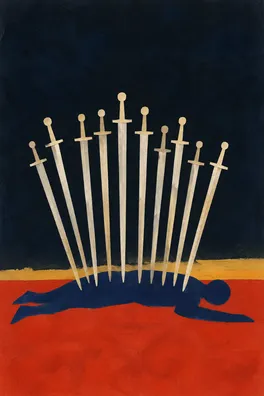
Ten of Swords
Reversed
The reversed Ten of Swords in A small next step suggests gradual recovery from a painful pattern. It can describe the hardest phase passing while old hurt still influences how much trust feels possible. A friendship does not have to return to its previous form for healing to begin. The next step may be repairing one interaction, accepting a changed level of closeness or choosing a more protective distance.
Write down a pattern you do not want to repeat, such as agreeing while resentful or using silence to test whether someone will chase you. Make the boundary observable: “I will ask for a different time when I am exhausted,” or “I will name a concern before canceling again.” An enforceable reminder is more helpful than promising never to feel hurt. Start with an interaction whose emotional stakes you can manage.
Recovery is not proof that the relationship is safe to resume, and lingering pain is not proof that repair is impossible. Look for repeated behavior: acknowledgment, changed follow-through and respect for limits. If those are absent, your small step may be to stop reopening the same negotiation. What you carry forward can be a clearer understanding of care, even when a particular friendship stays changed.
This group moves from the appearance of capability to the cost of care, then toward a different pattern after hurt. The Magician, reversed, asks whether your promises match your resources; The Empress, reversed, asks whether your resources include room for you. The reversed Ten of Swords allows a beginning that is modest enough to sustain. Together they suggest that reciprocity becomes easier to see when neither exaggerated offers nor unspoken depletion hides the real arrangement.
For the next week, choose one friendship and make one accurate offer alongside one honest limit. Ask for something small you would appreciate as well, such as a reply about a plan or a turn choosing where to meet. Observe how the conversation changes. If the friend is temporarily overwhelmed but responds with care, adjust the pace together. If you feel compelled to withdraw the limit to win reassurance, pause and return to what you can reliably give. The experiment is about making the relationship more legible, rather than testing someone without their knowledge.
A question to take with you
What would I offer, request or limit differently if I trusted that friendship did not have to be earned through being endlessly useful?
Group 2
Group 2
Connection
How can I make room for more honest, mutual connection?
01Where you are

The Sun
Reversed
The Sun, reversed, in Where you are describes warmth that is obscured rather than necessarily absent. Confidence may have taken a setback, or the demand to remain cheerful may make honest connection difficult. If you believe you must be interesting, healed or upbeat before spending time with someone, ordinary closeness can feel like an examination. The card invites you to notice what is already good without requiring it to look complete.
A conversation may have felt awkward, yet the other person remembered a detail or made time to return. Recognizing that small sign is different from assuming intimacy is guaranteed. Equally, a bright exchange may have left an important misunderstanding unspoken. Acknowledge real progress, then check one detail your optimism or perfectionism may have hidden: whether a plan was agreed, whether a joke hurt, or whether you felt able to disagree.
The alternative reading is that your disappointment points to a real mismatch, not a failure to appreciate enough. You do not have to manufacture joy to make a connection work. Try describing one experience accurately, including both its warmth and its discomfort. That gives the next conversation a more honest starting place than either forced positivity or a verdict that nothing good is possible.
02What needs attention
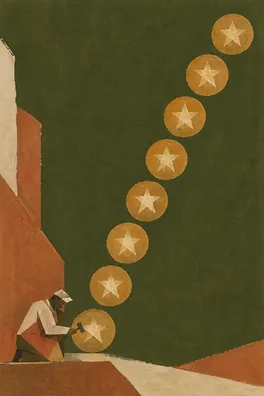
Eight of Pentacles
Upright
The upright Eight of Pentacles in What needs attention treats connection as something supported by learnable skills. Its diligence concerns a specific detail practiced with care, not perfect performance. Listening without preparing a defense, asking a clear question or responding to a request directly can each improve through repetition. This position suggests that the quality of an exchange may change when you work on one behavior within your control.
Choose a manageable skill for your next conversation. You might summarize what you heard and ask whether you understood, then leave space for correction. Afterwards, notice whether the other person had more room to speak and whether you learned something unexpected. Improvement is observable in the exchange; it is not measured by whether you received instant affection or agreement.
A blind spot would be turning every interaction into homework or taking sole responsibility for mutuality. Your practice can make an invitation clearer, but another person must still choose how to participate. If only you ask, repair and follow up, the next useful skill may be stating that imbalance. Allow room for ease and humor too, so attention to craft supports connection rather than replacing it.
03A small next step

Eight of Wands
Upright
The upright Eight of Wands in A small next step brings movement after waiting. News, invitations or several conversations may arrive close together, and an opening can be easier to use when you are clear about what comes next. The card’s speed does not require instant intimacy. It points toward a simple action that gives an existing possibility somewhere to go.
If you have been exchanging warm but vague messages, confirm one practical detail: a time for a call, a short walk or the question you would like to discuss. If several invitations arrive, acknowledge them and give realistic reply times instead of letting urgency determine your availability. Clear communication prevents momentum from carrying you past your preferences.
Rapid communication can also amplify misunderstanding. Before forwarding a personal message or interpreting a delayed answer, check context and consent. An enthusiastic burst is not yet a durable pattern of mutual care. Notice whether increasing contact leaves room for honesty, rest and a change of mind. Movement is most useful when both people can still say what pace suits them.
The Sun, reversed, makes room for an imperfect emotional beginning; the Eight of Pentacles offers a skill to support it; the Eight of Wands turns that practice into an actual exchange. The progression suggests that waiting to feel completely confident may postpone an ordinary opportunity for closeness. A truthful, modest invitation can create information that private rehearsing cannot provide.
During the coming week, acknowledge one thing you appreciated in an interaction, practice one listening skill and make one clear follow-up where it feels welcome. Give the other person space to shape the plan. If contact accelerates and you become tense, slow the pace rather than assuming more messages always mean more connection. If your invitation is declined, consider the explanation and the wider pattern without deciding that your worth has been judged. Mutuality becomes visible through freely chosen participation over time, including the freedom to set a limit.
A question to take with you
What small, truthful exchange would help me learn about this connection without demanding that it immediately prove its future?
Group 3
Group 3
Choosing a direction
What can help me clarify a choice without rushing?
01Where you are

The High Priestess
Reversed
The High Priestess, reversed, in Where you are suggests that outside voices may be drowning out a feeling you have not fully named. You may have collected many opinions while losing track of which concern belongs to you. Suppressed feelings, concealed information or uncertainty about what should remain private can all make a choice seem more mysterious than it is. This position invites careful acknowledgment before interpretation.
Suppose you are considering a course, role or change in routine, and everyone speaks confidently about what you should want. In a private note, name the feeling beneath your arguments: curiosity, reluctance, grief about leaving something or fear of disappointing someone. A feeling is information about your experience, not a complete verdict about the option. Place it beside the practical facts rather than demanding that one cancel the other.
Also ask whether an important detail needs clarification from the person who can actually answer it. Inner reflection cannot reveal an undisclosed schedule or another person’s intentions. Share only what is necessary when seeking advice, especially if the choice involves someone else’s private experience. A quieter setting may help you hear yourself, while a direct question may resolve what intuition cannot.
02What needs attention

Seven of Wands
Reversed
The reversed Seven of Wands in What needs attention describes pressure that is overwhelming your ability to hold a position. Constantly defending a preference can exhaust you until agreement feels like the only route to rest. Alternatively, you may be spending scarce energy protecting an old choice whose reasons have changed. This card asks which boundary still serves you and which argument no longer needs to continue.
Before answering a non-urgent request, pause and state when you can respond. Use that space to assess capacity: the hours available, the obligations already present and the support you would need. If a discussion has become repetitive, you can end the debate temporarily without pretending the decision is settled. A sentence such as “I need the schedule before I can answer” gives the pause a practical purpose.
Retreat can be wise recovery, but it can also become avoidance when no next step is named. Conversely, persistence is not automatically courage if you are defending something only to avoid embarrassment. Choose one boundary that protects the conditions for thinking clearly. Let go of one unnecessary defense, such as persuading every adviser to approve your preference, and notice whether that frees useful attention.
03A small next step

Eight of Swords
Upright
The upright Eight of Swords in A small next step recognizes a genuine sense of restriction. Some limits come from circumstances, while fear and habitual judgments can make the remaining options harder to see. The card does not suggest that every obstacle is imaginary or that you should simply think more positively. It asks you to describe the constraint precisely enough that help or adjustment becomes possible.
Replace “I have no choice” with one concrete statement, such as “the required session overlaps my work hours” or “I do not yet know the total cost.” Then identify a question within reach: whether another session exists, whether a deadline can move or who can explain the fees. An answer may reveal flexibility; it may also confirm that this option is presently impractical. Either result gives your reasoning a firmer basis.
If the limitation cannot change, explore which part of the choice remains yours, including timing, preparation or asking for support. Avoid treating one small opening as proof that every barrier can be overcome through effort. The useful next step is a bounded inquiry, followed by an honest update to your map of possibilities. Clarity can include recognizing that a path is closed for now.
These cards move from a crowded inner conversation through exhausted defenses toward a more accurate description of limits. The High Priestess, reversed, asks you to hear the feeling beneath the advice. The reversed Seven of Wands protects enough space to examine it. The Eight of Swords makes that space useful by turning a broad sense of helplessness into a specific question. Together they support a choice informed by both internal experience and external conditions.
For the coming week, take one decision out of the public debate long enough to write what you feel, what is known and what is still assumed. Choose one unanswered practical question and ask the relevant person, sharing only necessary details. Review the answer at a time you set in advance. If it changes the available options, update your view; if it confirms a hard limit, consider an alternative pace or route. When a decision is genuinely urgent, use the time available to identify the most consequential unknown rather than waiting for perfect calm. The aim is a clearer next step whose reasons you can explain to yourself.
A question to take with you
Which limit can I state as a fact, which feeling needs acknowledgment, and what single question could make my next choice clearer?