
Pick a group
Choose a group: a boundary, a habit, or a more open way to learn
Three personal readings explore how to use the resources you have, make daily care fairer, and give learning room beyond the need to prove yourself.
· AI-assisted readings from randomly drawn cards. For reflection and entertainment.
Take a breath. Pick the group that draws you in.
Group 1
Group 1
Boundaries
Where would a kind, clear boundary support me?
01Where you are

The Magician
Upright
The upright Magician in Where you are points to usable skill and agency. You may already know how to organize a task, express an idea or help a project move. That capability can make you the person others approach first. A boundary becomes relevant when being able to do something quietly turns into being expected to do it, regardless of your capacity or consent.
Imagine being asked to rescue another deadline because you have solved the problem before. The card’s focus on directing resources asks you to distinguish skill from unlimited availability. Your contribution may be valuable precisely because it requires attention that cannot be spent everywhere. It is also possible that nobody realizes the cost yet; the reading does not establish that another person is exploiting you.
Make something small with a resource already within reach: a brief availability note, a reusable explanation, or a clear description of the help you can offer. For example, you might offer to explain a process once without taking ownership of the whole task. Notice whether naming the scope makes cooperation easier. The blind spot is using articulate speech to manage everyone’s reaction. A clear boundary can be well expressed and still disappoint someone.
02What needs attention

Page of Swords
Upright
The upright Page of Swords in What needs attention asks for curious observation before a verdict. Alertness can help you notice an uneven pattern, but limited information can also turn a delayed reply or hurried request into a convincing story about someone’s intentions. A boundary is more useful when it responds to an observable arrangement rather than an accusation you cannot verify.
Look at one recurring exchange. What was requested, what did you agree to, and what happened afterwards? If the expectation is unclear, ask a direct question about responsibilities or timing. In a workplace, the relevant primary source might be the original task brief; in a household, it may be the agreement you actually made. Separate what those sources show from what you are guessing.
The Page’s inexperience is a reminder to leave room for correction. You can say that you understood the arrangement differently and ask to clarify it. Curiosity does not require endless investigation before you protect your time, especially when the limit is already evident. Stop gathering evidence once you have enough to name the practical need; otherwise research can become a way of postponing an uncomfortable conversation.
03A small next step
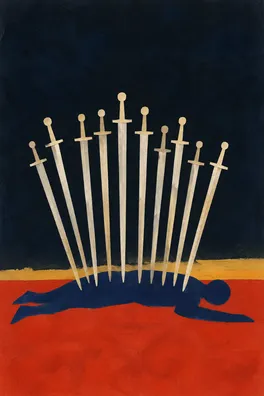
Ten of Swords
Reversed
The reversed Ten of Swords in A small next step suggests recovery after an exhausting ending or pattern. Its reversal allows a beginning without requiring you to feel entirely restored. If earlier attempts at saying no led to conflict, even a modest limit may carry the weight of that experience. Lingering pain deserves attention, but it need not write every new agreement.
Choose one pattern you do not want to repeat and build a boundary that you can actually enforce. If you repeatedly accept work while tired and regret it later, a reminder to check capacity before replying may be more useful than promising never to overextend again. If an exchange consistently runs beyond your energy, name its end time and plan what you will do when that time arrives.
Recovery may be uneven, and this card does not promise that the hardest phase has objectively passed. A limit can be too ambitious, unclear, or unsuitable for the situation. Review the attempt without calling it a personal failure: did you state it, could you follow through, and what support was missing? Carry forward the knowledge the experience gave you while allowing the next attempt to be smaller and more workable.
This group links capability, investigation and recovery. The Magician says that you have something useful to direct; the Page asks what is actually being asked of you; the reversed Ten of Swords encourages a limit that interrupts an old cost. Together they suggest that a kind boundary begins with a precise understanding of your contribution and capacity. Kindness includes the person who will have to live with the promise you make.
There is another possible reading: the difficulty may come less from another person’s demands than from your own habit of volunteering before checking what you need. In that case, the first boundary belongs inside the pause before an answer. If the arrangement is structurally unequal, however, better phrasing alone may not solve it. Clarifying responsibilities and finding practical support may matter more than making your words softer.
For one week, practice a single sentence that names what you can offer, its limit and when you can revisit it. Use it in a manageable situation and note the result afterwards. Did the sentence protect enough time? Was a responsibility still vague? Adjust the scope if it cannot be sustained; do not measure success solely by whether everyone approved. What would a boundary let you contribute with less resentment?
A question to take with you
What can I offer freely, and what limit would keep that offer honest?
Group 2
Group 2
Habits and intention
Which small habit would better reflect what matters to me?
01Where you are

Two of Wands
Reversed
The reversed Two of Wands in Where you are points to hesitation, limited planning or fear of unfamiliar ground. A valued habit may exist as a large picture of the person you hope to become, while the first ordinary step remains unclear. The gap can look like lack of commitment even when the real problem is a plan that assumes more time, certainty or energy than you have.
Consider wanting a quieter morning but designing a routine that only works when nobody needs you and you wake up perfectly rested. The reversal asks you to reconsider the route rather than judge the whole intention. Sometimes caution has a factual basis, such as an unpredictable schedule; sometimes it is the discomfort of trying something without knowing whether you will be good at it.
Find a low-cost exploration. Instead of rebuilding the morning, try a brief moment of preparation the night before, or place one needed item where you will use it. Record the practical obstacle you discover. The blind spot is shrinking a habit until it no longer serves what matters. A small step should still point toward your value, even while leaving room to learn what a realistic plan requires.
02What needs attention

Queen of Cups
Reversed
The reversed Queen of Cups in What needs attention asks whose feelings organize the day. Care can become self-sacrifice when every message, mood or request gets priority over your own basic needs. A habit meant to reflect your values may be repeatedly displaced because you feel responsible for keeping everyone else comfortable. This is a possibility to examine, not a diagnosis of you or another person.
You might notice that the time intended for rest becomes an open-ended conversation, followed by resentment you feel guilty for having. The card’s reversal brings blurred boundaries into view: empathy can recognize another person’s distress without taking full responsibility for resolving it. Equally, a difficult week of caring may reflect a real temporary need rather than a permanent pattern.
Try giving one draining exchange a clear time limit and include recovery time afterwards. Before and after it, name your own feeling in plain language. That helps distinguish concern for someone else from the exhaustion of ignoring yourself. If the limit feels harsh, offer a specific alternative you can sustain. The aim is to make care more honest, not to turn emotional independence into isolation.
03A small next step

Justice
Reversed
Reversed Justice in A small next step brings attention to bias, missing facts and uneven responsibility. In a habit reading, it can expose a double standard: you may excuse everyone else’s interruptions while treating your own need for consistency as unreasonable. It can also point the other way, toward blaming other people for a routine whose responsibilities you never clearly discussed.
Check one fact before deciding what is unfair. How much time does the habit take, who is currently carrying the surrounding work, and what was actually agreed? If you want a short period of uninterrupted study or movement, the practical question may be who covers a shared task during it. An apparently personal habit can depend on a household or team arrangement.
Make one responsibility explicit and apply a standard you could accept for everyone involved. If circumstances change, agree how the arrangement can be revised. The reversed card is not proof that somebody is dishonest, and a tidy schedule does not by itself make an unequal situation fair. Notice whether the new arrangement distributes both the opportunity and the inconvenience more openly, then adjust it using what happened rather than who argued most persuasively.
This group suggests that the habit most aligned with your values may be a fairer way of making room, rather than another demand for discipline. The reversed Two of Wands asks for a realistic experiment, the reversed Queen of Cups notices emotional overextension, and reversed Justice checks how responsibility is shared. A routine can fail because its design is poor, because care consumes its space, or because the agreement supporting it is uneven. Those causes call for different responses.
Choose one value and one small action that expresses it. If the value is presence, the action might be a short period without messages; if it is learning, it might be returning to one page with attention. Then name what must happen around that action for it to be possible. Ask for a specific arrangement where needed, and leave space for other people’s legitimate needs. The reading supports examining fairness rather than assuming that your first preferred schedule is the right one.
Over the next week, notice what interrupted the experiment and how you responded emotionally. If practical barriers repeat, revise the plan. If guilt repeatedly overrides an agreed limit, revisit the boundary. If someone else carries an unreasonable cost, change the arrangement. Let the evidence tell you which adjustment is needed. Which daily choice would make your stated values more visible without requiring you to disappear into everyone else’s needs?
A question to take with you
What small habit matters to me, and what fair agreement would give it room?
Group 3
Group 3
Learning
What approach could make learning feel more open?
01Where you are

Queen of Pentacles
Upright
The upright Queen of Pentacles in Where you are emphasizes practical care and reliable foundations. In learning, this can mean that openness begins with material conditions: a place to work, a usable resource, enough rest, or time that is not already promised elsewhere. Difficulty concentrating does not automatically mean that you lack curiosity. The environment may be asking more of you than it supports.
Imagine returning to a subject after a long break. Buying a demanding course might feel like commitment, while clearing a small surface and choosing an accessible starting resource may do more to help you begin. The Queen directs attention to care that meets your present needs rather than an impressive picture of how a serious learner should behave.
Improve one part of the space or routine you use most often. Keep the change modest enough to maintain, then notice whether returning becomes easier. Her blind spot is making comfort a condition that must be perfect before learning starts. A supportive foundation can include some inconvenience and uncertainty. The question is whether your resources make contact with the subject possible, not whether they remove every challenge.
02What needs attention
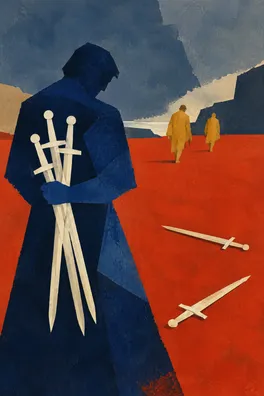
Five of Swords
Upright
The upright Five of Swords in What needs attention asks what the need to win is costing your learning. Discussion can become a contest in which being corrected feels like humiliation, or where displaying knowledge replaces trying to understand. Even a successful argument can leave less trust and fewer honest questions. This card invites you to notice that cost without assuming every disagreement is hostile.
You may recognize a class discussion where you stop listening while preparing a rebuttal, or an online exchange that leaves you informed about your opponent’s weaknesses but little wiser about the topic. If someone is actually ridiculing or bullying you, the response may be to leave that setting or seek a more respectful one. Openness does not require accepting mistreatment.
Write down what the disagreement is really about and omit one reply whose only purpose is to prove you are right. Replace it, when appropriate, with a specific question about the reasoning or evidence. Notice whether the exchange becomes more useful. The alternative reading is that honest challenge is being mistaken for an attack. A worthwhile learning space can contain disagreement while preserving dignity and allowing people to revise their views.
03A small next step

Ten of Pentacles
Reversed
The reversed Ten of Pentacles in A small next step turns toward inherited expectations and shared resources. A structure that once supported learning may now create friction: a family rule about worthwhile subjects, a shared device with unclear access, or a long-standing duty that absorbs every available hour. The reversal invites review of that structure rather than treating its age as proof that it still works.
Choose one responsibility whose scope has remained vague and discuss it with the people affected. If everyone assumes you are always available to solve a household problem, a protected learning period may need an agreed alternative. If money or equipment is shared, clarify access and limits before making a commitment. These are conditional examples, not a prediction of family conflict or financial loss.
Keep the first change small and reversible. A new agreement might specify one time window, who covers an existing task, and when to check whether the arrangement is fair. Notice what genuinely sustains the shared life and what continues only from habit. The blind spot is blaming every difficulty on inherited expectations; some commitments remain meaningful. The task is to distinguish support worth retaining from a structure that needs to change.
This reading moves from practical support, through the cost of rivalry, toward revising a shared structure. The Queen of Pentacles offers steadiness, while the Five of Swords asks whether the learning space rewards understanding or victory. The reversed Ten of Pentacles broadens the question to the responsibilities and expectations surrounding that space. Openness can require both an inner permission to be corrected and an outer arrangement that makes learning possible.
An alternative explanation deserves room: you may already have enough time and a respectful setting, while the subject itself is difficult. In that case, changing the environment repeatedly could postpone the ordinary discomfort of being a beginner. Use a specific attempt to find out. Choose a question you actually want to understand, set up one practical support, and work with it long enough to identify a real point of confusion.
During the coming week, bring that point to a resource or person who can explain it without turning the exchange into a contest. If a shared duty blocks the attempt, clarify one part of its scope. Afterwards, record what you understand better and what remains open. Adjust the resource if it is inaccessible, the agreement if it is unfair, or your approach if proving yourself has taken over. What might you become able to ask if you did not need the question to protect your image?
A question to take with you
Which practical support or shared expectation could I change so that asking an honest question feels easier?