
Pick a group
Choose a group: creativity, a realistic step, or a clearer boundary
Three different reflections on finding room to create, loosening a rigid expectation and protecting the foundations that support you. Choose the question that meets your situation today.
· AI-assisted readings from randomly drawn cards. For reflection and entertainment.
Take a breath. Pick the group that draws you in.
Group 1
Group 1
Creative energy
What would help my creativity find its way forward?
01Where you are
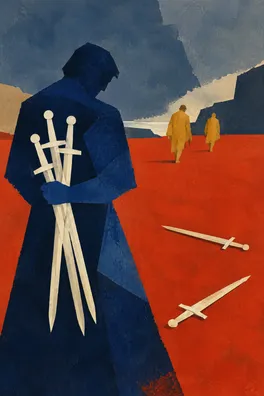
Five of Swords
Upright
The Five of Swords upright places conflict and hollow victory in Where you are. Creative energy may be getting drawn into proving that an idea is superior, defending every choice or comparing your progress with someone else's public success. The card's concern is the cost of winning: a technically successful argument may leave less trust, curiosity or willingness to make anything together. This is a possibility to examine, not a claim that someone around you is acting maliciously.
Perhaps feedback on a draft has become a dispute about competence. Or the contest is internal: each unfinished experiment becomes evidence in a case against your ability. In either situation, creating can begin to feel like appearing in court. Notice whether you are revising the work to serve its purpose or revising it to defeat an imagined critic. Those motives sometimes overlap, but they do not always lead to the same next action.
Write a plain sentence about what the disagreement is really protecting: quality, credit, autonomy or belonging. Drop one response whose only purpose is to establish that you are right. If there is an actual unfair arrangement, stepping out of a pointless exchange need not mean surrendering authorship or accepting mistreatment. The aim is to preserve enough dignity and energy to return to the work.
02What needs attention

The Chariot
Upright
The Chariot upright, in What needs attention, asks for a direction capable of holding competing forces together. Its determination is useful after the scattered struggle of the first card: the question becomes what you are trying to complete, rather than whom you need to outdo. You may want originality and reliability, freedom and a deadline, solitude and feedback. Progress can require steering those tensions rather than waiting for one side to disappear.
Choose a concrete destination small enough to recognize: a rough scene with a beginning and ending, a test recording, or one prototype that answers a question. Define completion before adding more preparation. If you keep collecting references, identify which remaining uncertainty truly prevents a first attempt. Removing an unnecessary step is an act of direction, not evidence that you care less about quality.
The caution is force without listening. Determination will not resolve a missing skill, an inaccessible tool or an unrealistic agreement simply by becoming more intense. If the obstacle is practical, seek the relevant help or change the scope. Use willpower to protect the next useful action, while allowing the method to change when the work teaches you something.
03A small next step

Two of Pentacles
Upright
The Two of Pentacles upright makes adaptation the small next step. Its balancing of time, money and competing responsibilities brings the reading into the actual shape of your day. You do not need to create an ideal life before creativity can resume. You do need a workable exchange between what the project asks and what your present resources can sustain.
Try moving a demanding creative task into a period when your attention is usually better, and a simpler administrative task into the less energetic slot. If only fifteen minutes are available, use them for a bounded experiment rather than compressing a whole imagined session into them. Decide what can wait, what can become smaller and what genuinely needs protection. Balance here is ongoing adjustment, not an achievement you must maintain perfectly.
Flexibility can become avoidance if the creative task is always the one postponed. Conversely, treating every free moment as productive time may remove the rest that makes ideas possible. After the experiment, notice whether the revised timing helped you begin and left enough capacity for ordinary responsibilities. That observation gives you a better basis for tomorrow than a judgment about how disciplined you should have been.
This group moves from costly competition to purposeful steering and then to a rhythm you can actually live with. The Five of Swords asks what the struggle is consuming. The Chariot restores a destination, and the Two of Pentacles makes the route adjustable. Together they suggest that creativity may need a different relationship with effort: less energy spent defending your worth, more spent finishing a meaningful experiment within real constraints.
An alternative explanation deserves room. You may already have a clear direction and reasonable schedule, while the collaboration itself is unfair. In that case, better time management will not repair the underlying agreement. Clarify ownership, feedback or responsibilities before expecting yourself to become more efficient. If the conflict is mainly internal comparison, reducing exposure to competitive feeds may give the work more room to develop privately.
For the next week, select one modest piece to complete, name one argument you will stop rehearsing, and arrange two workable sessions around your actual energy. After each, record what advanced the piece and what depleted attention. If the scope keeps spilling over, shrink the piece; if isolation stalls it, request one specific form of feedback. Let the evidence of making something guide the next adjustment.
A question to take with you
What could I finish with more curiosity if I no longer needed it to prove that I deserved to create?
Group 2
Group 2
Your next small step
Where could one small, realistic step make a difference?
01Where you are
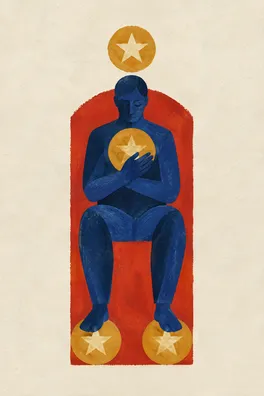
Four of Pentacles
Upright
The Four of Pentacles upright, in Where you are, recognizes the value of keeping something secure. Savings, dependable routines, private time and familiar methods can be foundations rather than obstacles. If resources have been stretched, holding steady may be sensible. The card also asks when preservation begins to organize your whole life around preventing any possible loss.
You might keep postponing a manageable conversation because it could disturb a settled arrangement, or decline every new activity because an unallocated hour feels unsafe. Alternatively, your hesitation may accurately reflect limited capacity. The distinction matters: a small next step should not require you to gamble with basic needs merely to demonstrate openness. Begin by naming what really must remain protected and what is only familiar.
Make a short inventory of the essentials involved in this decision, such as a minimum rest period, an agreed spending limit or an existing responsibility. Then identify one adjustment that leaves those basics intact. Notice whether having an explicit boundary makes experimentation easier. A boundary can support movement when it tells you where there is room, rather than requiring everything to stay exactly as it is.
02What needs attention

Queen of Wands
Reversed
The Queen of Wands reversed brings insecurity, comparison and fading enthusiasm into What needs attention. In this position, it may describe how the pressure to appear capable has become tangled with what you actually want. You could be protecting resources with one hand while accepting extra obligations with the other, simply because declining them feels like admitting that someone else is more confident or impressive.
Consider one commitment that leaves you irritable before it even begins. Was it chosen from interest, necessity or the wish to prove you could handle it? There may be legitimate duties you cannot immediately set down. Even then, you can distinguish the duty from the extra performance layered onto it: unnecessary polish, instant availability or taking responsibility for everyone's approval.
The reversed card is not a character judgment and does not establish that you are jealous or selfish. It invites you to notice where confidence has become dependent on an audience. Withdraw or renegotiate one optional promise made chiefly to prove yourself. Observe whether energy returns, or whether another practical obstacle becomes clearer once the performance demand is reduced.
03A small next step

The Hierophant
Reversed
The Hierophant reversed places questioning inherited answers in A small next step. Following the first two cards, it suggests examining a rule that keeps security and self-worth unnecessarily entangled. Perhaps you learned that responsible people never change a plan, that asking for help signals weakness, or that a worthwhile project must follow an approved sequence. A familiar rule may contain useful wisdom while fitting your present circumstances poorly.
Choose one piece of advice and write down its intended purpose, the conditions under which it helps and the point where it stops helping. Then try a limited alternative. You might ask for clarification before agreeing, use a simpler method for a low-stakes task, or allow a trial period before making a lasting commitment. Make the experiment small enough that its effects can be observed without undermining the essentials you identified earlier.
Rebellion can become another rigid role if every established method must be rejected. Expertise and shared standards can still protect you, especially where real obligations are involved. The useful question is whether this particular rule has a sound reason here. Keep what serves your experience and values, and revise what survives only because an authority once said it.
The Four of Pentacles protects the foundation; the reversed Queen of Wands notices the cost of performing confidence; the reversed Hierophant questions the rule that may bind the two together. The movement is toward a smaller, more honest form of freedom. You can retain sensible limits while loosening a standard that makes every decision a test of your worth.
This reading could fit someone with enough resources who remains afraid to experiment, but it could also fit someone who is genuinely overextended. In the second situation, the useful step may be reducing a commitment or asking for practical support. Expanding your ambitions would miss the point. Let your actual capacity, rather than the appeal of a brave-looking gesture, determine the size of the experiment.
During the coming week, protect one essential, renegotiate one unnecessary performance and test one familiar rule in a reversible way. Write down what you expected would go wrong and what actually happened. If the experiment strains the essential, narrow it or stop; if it frees energy without creating a new burden, consider repeating it. The result is information about your circumstances, rather than a final verdict on your courage.
A question to take with you
Which rule could I question gently while keeping the resources and responsibilities that truly support me?
Group 3
Group 3
Boundaries
Where would a kind, clear boundary support me?
01Where you are

Ten of Pentacles
Upright
The Ten of Pentacles upright places shared foundations and lasting security in Where you are. A boundary may matter because you belong to something you want to sustain: a family, a household, an enduring friendship or a project built over many years. The card recognizes the value of accumulated resources and experience. It also invites you to consider how the work of maintaining them is distributed.
Perhaps you have become the default organizer of a family responsibility or the person everyone asks to resolve uncertainty. Being trusted can feel meaningful while the practical burden grows quietly. The issue may involve money or shared property, but it can also involve time and knowledge passed between people. A durable arrangement needs more than one person's unspoken willingness to keep absorbing the work.
Identify the shared good you want to protect before defining the limit. Review who benefits, who decides and who carries the recurring tasks with the people involved. Avoid assuming that an uneven arrangement proves bad intentions; people may be following a pattern nobody has examined. A clear conversation can honor the relationship while making its long-term support more realistic.
02What needs attention
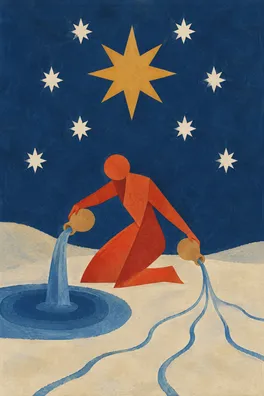
The Star
Reversed
The Star reversed, in What needs attention, brings shaken hope and difficulty feeling supported into view. When an arrangement has disappointed you repeatedly, a request for change may feel pointless before you begin. You might keep giving because you fear nothing would improve if you stopped, or retreat so completely that even a concrete offer of help becomes hard to accept.
Treat that loss of confidence as something to notice, rather than proof that the future is settled. Reduce a distant hope such as a fairer household to one observable task: another person handles a specific appointment, or information is placed where everyone can access it. A real, limited response gives you something firmer to assess than a general promise that things will be different.
The caution is expecting a single successful exchange to restore all trust, or a single imperfect one to erase every possibility. Support can be partial and still useful. If the request receives no workable response, that is information for adjusting your own availability and seeking another source of practical help. Hope becomes more grounded when it has evidence and limits.
03A small next step

Page of Swords
Reversed
The Page of Swords reversed makes careful communication the small next step. Its themes of gossip, weak reasoning and defensive speech are especially relevant when boundaries have been discussed through indirect messages. You may receive a secondhand account of what someone supposedly expects, or find yourself rehearsing a sharp reply to an intention that has never been confirmed.
Before passing the message along or responding to its implied accusation, check the source and separate what was said from what you inferred. Then state the boundary with a concrete scope: I can coordinate this task until Friday; after that, someone else needs to take responsibility. If you need information, ask the person who can answer rather than assembling certainty from fragments. Kindness here includes giving others a clear account of what you can actually do.
Verification should not become endless interrogation, and you do not need to win an argument about another person's motives before setting a limit. Some questions clarify responsibility; others only prolong the drain on attention. If conversation becomes circular, restate the practical arrangement and choose a suitable time to revisit it. Keep the focus on actions and confirmed information.
This group treats a boundary as part of caring for something that should endure. The Ten of Pentacles names the shared foundation, the reversed Star acknowledges how disappointment can weaken confidence, and the reversed Page of Swords asks for communication that does not add suspicion or unverified claims to the burden. The aim is an arrangement people can understand and sustain, with room for your needs inside it.
A different possibility is that others are willing to help but do not know what support would be useful. A specific request can reveal that. If there is a repeated pattern of promises without action, clearer wording alone may not change it; the boundary may need to be expressed through what you take on and when you become unavailable. Neither interpretation requires you to claim certainty about anyone's intentions.
This week, choose one recurring responsibility, confirm the facts directly and propose a clear division or limit. Accept one concrete offer of help if it meets the need. After the agreed period, assess what actually changed: the task, the workload and your capacity to continue. Adjust the arrangement when the evidence calls for it, rather than measuring success solely by whether the conversation felt comfortable.
A question to take with you
What limit would help our shared foundation last while giving my time and needs an explicit place within it?