
Pick a group
Choose a group: courage, purpose, or a beginning you can build
Three personal readings on lowering a guard, making work more workable and giving a new interest a fair chance to grow.
· AI-assisted readings from randomly drawn cards. For reflection and entertainment.
Take a breath. Pick the group that draws you in.
Group 1
Group 1
Everyday courage
What might a gentle act of courage look like today?
01Where you are
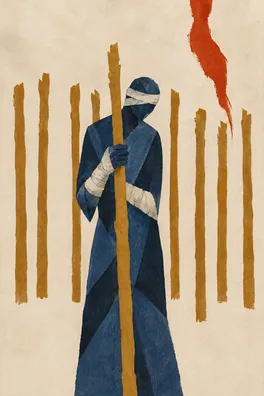
Nine of Wands
Reversed
The Nine of Wands reversed in Where you are suggests that the effort of staying ready may be taking more energy than the problem immediately in front of you. Its meaning includes exhaustion and defenses becoming isolation, but also the beginning of lowering a guard. A gentle act of courage may therefore start with admitting that constant readiness is tiring, rather than proving you can endure another demand.
You might recognize this in rehearsing a difficult conversation long before it happens, declining help because explaining feels burdensome, or answering an ordinary request as though it carries the weight of an older disappointment. These are possible situations, not conclusions about your life. The important distinction is whether a boundary protects something present or whether it has become an automatic defense against any uncertainty.
Choose one trusted person and describe one specific thing you have been bracing for. Ask for a practical suggestion or a small piece of help, rather than requiring yourself to explain the entire history. If no person currently feels trustworthy, begin with a private note about what support would look like. Lowering a guard is not a duty to grant access; notice whether the step leaves you better supported or simply more exposed.
02What needs attention

Three of Swords
Reversed
The Three of Swords reversed brings recovery, letting go and the possibility of reconciliation to What needs attention. In this position it asks for room around a hurt that may be easing unevenly. Having a painful feeling again does not establish that nothing has changed. Equally, a quieter day does not require you to declare the matter resolved before you are ready.
Perhaps a small misunderstanding now echoes a past rejection, or you are considering an apology while unsure whether renewed closeness would be good for you. Separate the event you can describe from the judgment you have attached to yourself. “They did not answer that message” is an observation; “I always ask for too much” is a broader conclusion that the observation cannot settle. Your need for clarity or consideration can remain legitimate even when the interpretation changes.
Write the recurring thought, then give fact, assumption and need their own lines. Choose one response that serves the need today: request clarification, allow disappointment, or stop rereading an old exchange. Reconciliation is one possibility, not the required destination of healing. The blind spot is using the language of letting go to hurry past a feeling that still needs acknowledgment; allow relief and sadness to coexist.
03A small next step

Seven of Wands
Reversed
The Seven of Wands reversed in A small next step recognizes overwhelm and the possibility of weakened boundaries. After the first two cards, retreat may be a deliberate reduction of pressure rather than a verdict on your courage. The question is which demand can be reduced without abandoning what matters to you.
If several people need an answer, try pausing on one non-urgent request and checking your actual capacity. You could offer a smaller contribution, ask for more time or decline with a short explanation. A long defense can recreate the very fight you are trying to leave. The step should make your limit clearer, not turn every relationship into a contest over who understands your tiredness.
There is another reading to consider: perhaps you have withdrawn from something meaningful because being seen trying feels risky. In that case, a small supported return may serve you better than another refusal. Compare the likely cost of one bounded attempt with the cost of continuing to avoid it. Courage here is proportionate: preserve the boundary that helps you participate, and loosen the defense that keeps all participation out.
These three reversed cards form a reading about changing the terms of effort. The Nine of Wands notices the strain of vigilance, the Three of Swords makes space for recovery, and the Seven of Wands asks which struggle still deserves your energy. Together they suggest that a gentle act of courage may be a truthful admission followed by a practical limit. You do not have to settle every older hurt before making today more manageable.
For this week, choose one recurring moment when you brace automatically. Before it happens, identify one need and one possible support. During the moment, try a single sentence that names a limit or asks for help. Afterwards, record what actually happened and what you had feared would happen. A useful result may simply be discovering that the request was tolerated, or that a particular person was less able to help than you hoped.
Adjust the experiment if sharing leads to dismissal, pressure or more work for you. A different person, a smaller request or a firmer boundary may fit better. If the main obstacle proves to be uncertainty rather than exhaustion, try one supported step toward participation. What would courage look like if it included protecting your capacity as carefully as protecting your pride?
A question to take with you
Which part of my effort protects what matters now, and which part is an old defense asking for a gentler arrangement?
Group 2
Group 2
Work and purpose
What deserves my attention in my work right now?
01Where you are

Three of Cups
Upright
The Three of Cups upright in Where you are places connection and shared encouragement around your work. Its celebration is not limited to a major success. It can point to the quieter value of colleagues noticing progress, friends helping you remember a purpose beyond a task list, or a group making difficult work feel less solitary.
If work has become a sequence of private obligations, a brief conversation about a completed piece may restore context. Name what another person contributed and let your own contribution be visible too. This differs from seeking approval for every step: the card’s support comes from reciprocal attention and shared enjoyment, rather than constant evaluation.
If your workplace does not currently feel welcoming, do not force intimacy with coworkers. A friend, peer group or former collaborator may provide a more suitable connection. Arrange a short catch-up and celebrate one concrete thing in each person’s life. Notice whether the exchange renews your energy or becomes another performance; community deserves care, and it also needs room for honest limits.
02What needs attention

Nine of Swords
Reversed
The Nine of Swords reversed in What needs attention holds two possibilities: worry may be beginning to ease through conversation, or distress may be growing more private. The orientation does not let us assume which is true. In the context of work, the useful question is whether a concern is becoming clearer and more shareable or merely less visible to other people.
You might be repeatedly checking an unfinished task because its success criteria are unclear, or carrying a fear about feedback that has never been discussed. Bring the concern down to a specific sentence. A concrete problem such as “I do not know which version is expected by Friday” offers a place to begin; a global verdict such as “I am failing at everything” can obscure that place.
Tell a trusted person what kind of support you want: listening, a second look or help clarifying priorities. They may not be able to resolve the situation, and you can still gain a more accurate picture. The blind spot is turning every conversation into reassurance that must be renewed an hour later. Look for one usable clarification, then notice what changes when you work with it rather than checking again.
03A small next step

Knight of Pentacles
Reversed
The Knight of Pentacles reversed in A small next step asks whether a dependable routine has become inertia. Its themes include stubbornness, stalled progress and effort with little return. After cards about support and unspoken worry, this can describe a procedure maintained because it feels safer than exposing unfinished work or asking whether the procedure is still needed.
Choose one repeated step that consumes time without clearly improving the result: rewriting a status update, arranging notes before starting, or checking information nobody uses. Simplify that step once. State the purpose it must still serve so that the experiment is responsible. You might replace a long update with a short progress sample and one question for the recipient.
Not every slow process is wasteful. Careful review may protect quality, and constraints outside your control may explain a delay. Before changing a shared routine, ask whose work depends on it and agree on what a successful simplification would preserve. The point is to restore movement with feedback, not label yourself lazy or remove safeguards simply because they are tedious.
This group directs attention toward the conditions that let useful work happen. The Three of Cups offers connection, the reversed Nine of Swords asks for a specific worry to become speakable, and the reversed Knight of Pentacles looks for a routine that no longer earns its effort. Purpose may become easier to feel when support, clarity and method improve together.
During the coming week, arrange one short conversation with someone whose perspective you trust. Share a small completed piece, name one uncertainty, and propose one modest simplification. Then try the change on a bounded task and compare the result with the purpose you set. Did the work become clearer, did another person receive what they needed, and did less checking free attention for the actual task?
If the change causes confusion or shifts hidden work onto someone else, revise it together. If it changes little because the workload itself is unrealistic, the next conversation may need to concern priorities or resources. A routine is not the only possible cause of strain. Which part of your work would gain most from an honest conversation, and which part would gain most from being made simpler?
A question to take with you
Am I maintaining this way of working because it serves a clear purpose, or because changing it would make an uncertainty visible?
Group 3
Group 3
A fresh start
What is ready for a new beginning in my life?
01Where you are

Three of Pentacles
Upright
The Three of Pentacles upright in Where you are suggests that a beginning can grow from skills already present and a willingness to build with others. Its collaboration is practical: people contribute different abilities around a shared result. You may not need a complete reinvention so much as a setting where your contribution becomes clearer and another person’s expertise can meet it.
This could be a learning project, a shared household change or a creative idea that has remained private because it feels incomplete. Show a sample rather than trying to explain the whole future. A sketch, a short plan or a first attempt gives a collaborator something real to respond to and can reveal where their knowledge would help.
Recognized craftsmanship takes practice, but do not let a wish to seem competent keep you from asking a basic question. Agree on the next contribution and the standard you are working toward. The alternative is that the project needs more individual exploration before a team forms; in that case, a limited conversation with a mentor may fit better than a large commitment.
02What needs attention

Justice
Upright
Justice upright in What needs attention asks for fair judgment, facts and responsibility before the beginning gathers momentum. A fresh start can feel liberating, yet choices still create obligations. This position makes the practical terms part of the invitation: what is being promised, who is affected, and whether the same standard is applied to everyone involved.
For example, excitement about a joint project can hide different assumptions about time, ownership or credit. Put those assumptions into ordinary language and ask the other person how they understand them. You do not need to imagine a dispute to benefit from clarity. A specific agreement gives enthusiasm somewhere stable to go and makes later adjustments easier to discuss.
Add one relevant fact to your assessment and consider another explanation for a hesitation. What looks like lack of commitment may be a scheduling constraint; what looks like fairness to you may distribute work unevenly. Justice also asks you to include your own needs in the standard. Accuracy is not self-punishment, and responsibility does not require accepting every task to prove you deserve a place.
03A small next step

Page of Wands
Reversed
The Page of Wands reversed in A small next step addresses enthusiasm without direction and difficulty following through. Beside the first two cards, it suggests giving a new interest a place to practice before asking it to become an identity or a public success. Excitement is useful energy, but it needs a small container.
Arrange one short exercise: make a rough example, try a beginner lesson or test one part of an idea. Decide when you will stop, and postpone judging the result until the session is over. If collaboration is involved, explain that you are exploring rather than promising a finished outcome. That protects both your room to learn and the other person’s expectations.
A disappointing first attempt may reveal missing instruction rather than lack of ability. On the other hand, if interest repeatedly vanishes when the imagined applause is removed, that is information worth noticing. You can revise the project or let it remain a curiosity. The step is to discover what draws you into practice, not force every spark to become a permanent obligation.
The Three of Pentacles offers a way to begin through contribution, Justice asks that the contribution rest on clear and fair terms, and the reversed Page of Wands makes room for imperfect practice. Together they describe a beginning that becomes credible through a small real example. You do not need certainty about the entire path, but clarity about the next promise will help.
For the coming week, pick one idea and make a modest sample. Share it with one suitable person, ask a concrete question, and clarify whether you want feedback, teaching or collaboration. Before agreeing to anything larger, write down each person’s next step and the time it can realistically receive. Then complete one short practice session without turning the result into a verdict on your future.
Adjust if the arrangement becomes unequal, if the sample reveals a skill you need to learn first, or if the interest changes after contact with the actual work. Each finding can improve the beginning. An alternative path may be a period of private learning before collaboration; fairness includes allowing that pace. What new start would become possible if you offered a sincere contribution before trying to offer a finished version of yourself?
A question to take with you
What small piece can I make real, and what fair agreement would give me enough room to keep learning?