
Pick a group
A little room before the next step
Choose a group for reflection on direction, learning, or a more sustainable rhythm. Each reading explores a different way to move with care rather than hurry.
· AI-assisted readings from randomly drawn cards. For reflection and entertainment.
Take a breath. Pick the group that draws you in.
Group 1
Group 1
Choosing a direction
What can help me clarify a choice without rushing?
01Where you are

Ten of Pentacles
Upright
The Ten of Pentacles upright places lasting security and shared foundations in Where you are. A choice may feel unusually weighty because its consequences seem to extend beyond your own preferences. You might be weighing a move against family responsibilities, a new role against dependable income, or a personal ambition against an arrangement others rely on. The card invites you to recognize what has taken time to build before deciding what should change.
That recognition need not become an obligation to preserve every inherited arrangement. Security can mean money, but it can also mean dependable care, useful knowledge or a relationship that allows honest discussion. Make a short account of what your current situation actually supports and who participates in maintaining it. Distinguish an explicit responsibility from a role you have assumed without discussion. The latter may be negotiable even if it has felt permanent.
A blind spot here is treating the most established option as the only mature one. Something can endure because it works, or because nobody has felt free to question it. Ask which parts of the foundation you genuinely want to carry forward. A clearer choice may begin by protecting a valuable commitment while changing the method used to meet it.
02What needs attention

Four of Wands
Reversed
The Four of Wands reversed brings uncertain belonging and fragile support into What needs attention. You may have a workable long-term plan while still feeling uncomfortable in the daily environment around it. For example, people may endorse your goal but offer little practical help, or a familiar home or team may no longer feel like a place where your needs can be spoken. The reversal gives that mismatch a voice without proving that anyone intends to exclude you.
Before using discomfort as the sole argument for leaving or staying, make it specific. Is the difficulty a lack of privacy, an unclear division of tasks, a postponed conversation or the expectation that everyone must celebrate the same outcome? Name one small need to the people involved, such as a quiet evening for thinking or an agreed time to discuss responsibilities. Their response can provide information that speculation cannot.
This card can also describe a transition whose support is still taking shape. Temporary awkwardness is different from an arrangement that repeatedly dismisses your needs. Notice whether a reasonable request leads to workable adjustment over time. If it does not, the choice may need to account for that limit; if it does, you may discover that the foundation can change with you.
03A small next step

Three of Cups
Upright
The Three of Cups upright puts friendship and shared support in A small next step. After the weight of long-term obligations and the uncertainty of belonging, this is an invitation to recover a social perspective that does not require a final decision. Meet or call someone who can listen without making your choice a referendum on their own life. Begin by sharing one small thing that has gone well for each of you, so the conversation includes more than the problem.
Then ask for a bounded kind of help: listening while you describe two options, recalling a strength you forget under pressure, or exploring what practical support would be available during a transition. A friend’s warmth can make an uncertain process more bearable, but agreement is not evidence that an option is right. Keep responsibility for the decision with yourself and the people directly affected.
If a group tends to turn every conversation into advice, choose one person and state that you are still exploring. Community is most useful here when it widens your sense of possibility while respecting your pace. Afterwards, notice whether you feel clearer about your own priorities or merely relieved that someone approved of them.
This reading moves from what can endure, through the discomfort of belonging, toward support that allows a choice to become more honest. The Ten of Pentacles asks you to take shared responsibilities seriously. The reversed Four of Wands asks whether those responsibilities have a daily structure that supports you too. The Three of Cups suggests that perspective may return through a manageable conversation rather than another private round of rehearsing every possible outcome.
An alternative reading is that the direction itself is already reasonably clear, while the prospect of disappointing familiar people makes it feel unresolved. Another possibility is that the environment needs a practical adjustment before you can judge the choice fairly. You can explore both without announcing a final answer. During the coming week, identify one commitment to preserve, make one specific request about your surroundings, and arrange one supportive conversation.
Review what each step reveals. Did someone offer actual help, or only enthusiasm? Did a small environmental change make one option easier to imagine? If discussion becomes pressure to decide, narrow the conversation and return to your own criteria. The experiment is useful when it reveals the conditions under which a choice could be lived, rather than simply making the choice sound attractive. What would security look like if it included your own sense of belonging?
A question to take with you
Which responsibility do I freely choose to carry forward, and which expectation needs an honest conversation?
Group 2
Group 2
Learning
What approach could make learning feel more open?
01Where you are

Page of Wands
Reversed
The Page of Wands reversed places scattered enthusiasm or difficulty following through in Where you are. You may enjoy imagining what a new skill will allow, then feel deflated when the first attempts are ordinary. Or you may have received disappointing feedback and begun to treat the whole interest as a mistake. The reversal invites curiosity about the conditions of practice rather than a fixed judgment about your ability.
A concrete example might be moving between tutorials whenever an exercise becomes uncomfortable. Each new beginning restores excitement, but none gives you enough repetition to see what is improving. Try one short exercise with one resource, and postpone evaluation until it is finished. Make the goal an observable action, such as drafting a paragraph or completing a simple study, rather than producing something impressive.
Lack of follow-through can also reflect limited time, an unsuitable teaching method or a subject that no longer interests you. More willpower is not always the missing ingredient. After the exercise, ask whether the obstacle was confusion, fatigue, fear of being seen or a genuine change in interest. That distinction gives the next attempt a better starting point.
02What needs attention
Five of Wands
Upright
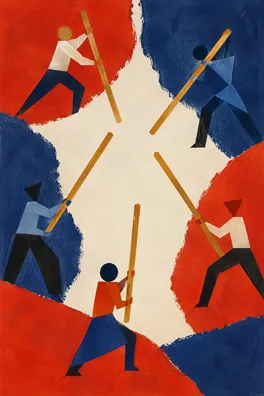
The Five of Wands upright brings competing approaches and the struggle for recognition into What needs attention. Learning becomes crowded when several voices insist on different methods or when peers appear to progress faster. Some friction can sharpen understanding; some merely shifts attention from the work to proving who belongs. The card asks you to distinguish a useful challenge from a contest that has lost its shared purpose.
In a study group or feedback conversation, agree on one goal before comparing methods. You might ask everyone to discuss whether an explanation is clear before debating style, and give each person a turn. If you are learning alone, apply the same principle to your resources: choose one question and compare how two approaches answer it. A disagreement becomes informative when you can name exactly what differs.
The blind spot is assuming that openness means accepting every opinion equally. Feedback can be specific, relevant and testable, or it can simply express a preference. Keep what helps you try something observable, and allow unresolved differences to remain unresolved for now. You can learn from a challenge without making another learner your opponent.
03A small next step

The Tower
Upright
The Tower upright in A small next step can feel disproportionate, but the useful focus is an exposed assumption rather than a predicted catastrophe. Learning sometimes opens when a familiar explanation fails. A program that breaks, an argument that contradicts your evidence or a technique that works only in one example may reveal that the foundation needs attention. The card offers no promise of a crisis in your life.
Choose a small, contained way to check one assumption. Explain a concept without looking at your notes, try a method on a different example, or ask which condition must hold for your answer to work. Keep a copy of your work and allow time to revise, following the card’s emphasis on reviewing a backup plan. The experiment should be small enough that an unexpected result is information you can use.
If an important commitment already feels unstable, the next step may be protecting what still works before inviting further challenge. You do not need to manufacture upheaval to learn. Let an exposed gap change the explanation or the practice schedule rather than your entire sense of competence. Finding a weak foundation early can make subsequent effort more meaningful.
The reversed Page of Wands suggests that excitement needs a place to become practice. The Five of Wands introduces the friction of different approaches, and the Tower asks whether an assumption can withstand contact with an example. Together, they support a form of openness that includes both experimentation and the willingness to revise. Neither constant novelty nor constant self-criticism gives learning much room to deepen.
For the coming week, select one modest skill, one short exercise and one assumption to check. Finish the exercise before searching for a new method. Invite a specific piece of feedback or compare two explanations, then record what surprised you and what you will try differently. Keep the original attempt so that revision has a visible reference point. This turns an uncomfortable discovery into something more concrete than “I am bad at this.”
If the exercise repeatedly leaves you exhausted or confused, reduce its size or change the support available. If you are only collecting praise, choose a slightly more revealing example. The experiment should make the learning process easier to observe, not turn every attempt into a public test. Which belief about being a good learner could you loosen enough to let an unfinished attempt teach you something?
A question to take with you
What could I discover if I treated an exposed gap as information rather than a verdict on my ability?
Group 3
Group 3
Rest and renewal
Where could I welcome a more sustainable rhythm?
01Where you are

Knight of Cups
Upright
The Knight of Cups upright places heartfelt action and an inviting vision in Where you are. You may already sense what would feel renewing: a quiet walk with someone, time for a creative interest or a gentler way to mark the end of the day. This card gives feeling a practical opening. Renewal can begin with an invitation rather than a complete redesign of your routine.
Make that invitation clear and easy to decline. You might ask a friend for a short walk at a stated time, or offer yourself a small period for music or drawing without a finished result. A defined invitation makes it easier to tell whether the activity fits the energy actually available. It also respects another person’s pace rather than asking them to become responsible for your renewal.
The Knight’s idealism can create another demanding picture of how rest should look. A beautiful plan may be less restorative than something plain and repeatable. Notice whether you are drawn to the activity itself or to the imagined version of yourself who does it perfectly. Keep the feeling that matters, and simplify the form.
02What needs attention

The Hermit
Reversed
The Hermit reversed places the boundary between solitude and isolation in What needs attention. Time alone can restore perspective, yet withdrawal may also leave you circling the same worries without help. The reversal invites an honest distinction between quiet that reconnects you with yourself and distance that makes ordinary contact harder. It does not establish why you feel tired or require one universal remedy.
Look at what tends to happen after a period alone. Do you return with more room for daily life, or do messages and simple tasks feel increasingly difficult to approach? If solitude has become disconnection, send a small message to someone trusted without requiring a long conversation. If quiet is constantly interrupted, protect a brief period and explain when you will be available again. The practical step depends on which need is going unmet.
A blind spot is borrowing someone else’s idea of balance. One person may need company after an isolated week; another may need permission to stop being available. Notice the effect of a small adjustment before deciding you need a different personality. Helpful guidance can be accepted selectively while you keep authority over your own pace.
03A small next step
Five of Swords
Upright
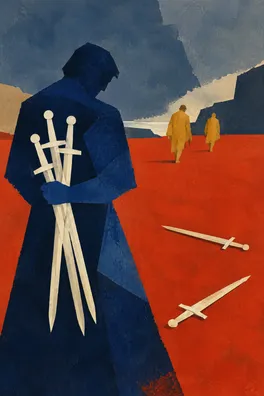
The Five of Swords upright brings the cost of winning into A small next step. In a reading about rest, it asks where an argument continues to consume energy after the conversation has ended. You might rehearse a perfect reply, monitor whether someone admits fault or keep defending a minor point because yielding feels like humiliation. Those habits can keep a conflict active during the very time set aside for renewal.
Write down what the disagreement is actually about and what you want the interaction to leave behind. Then drop one response whose only purpose is proving you are right. You might postpone a reply until a calmer time, ask for a practical arrangement, or leave a circular discussion with a clear boundary. Choosing a less costly response does not require pretending the original hurt was acceptable.
This card also includes unfair contests, so reconciliation is not always the useful aim. If an exchange repeatedly becomes hostile, reducing participation or seeking trusted support may serve you better than explaining yourself again. The small step is to stop paying for an empty victory with the attention you need for your own life.
The Knight of Cups begins with a genuine wish for a gentler rhythm. The reversed Hermit asks what kind of contact or quiet would actually support it. The Five of Swords then identifies a possible drain: the need to keep an argument alive until the ending feels fair. Renewal in this reading includes both welcoming something nourishing and withdrawing attention from a contest that offers little repair.
There are other possibilities. The conflict may be internal, such as trying to prove that you deserve a break by finishing an impossible list. Or the difficulty may be too much availability rather than too little connection. Use the reading to locate a pattern you recognize, without forcing every card into one account. During the coming week, try one low-pressure invitation, one adjustment to quiet or contact, and one deliberate pause in a repetitive argument.
Notice the effects in ordinary terms: was the invitation easy to keep, did the quiet leave you more present, and did the pause free attention for something you value? If a boundary creates a practical problem, clarify the arrangement; if a social plan becomes another obligation, shorten it. A sustainable rhythm can be revised around real experience. What could you stop trying to win so that something more restorative has room to begin?
A question to take with you
Do I need more quiet, renewed connection, or freedom from a contest that keeps consuming my attention?