
Pick a group
A little more room: three readings for space, habit and learning
Choose the question that stays with you. Each group explores a different way to loosen pressure and make a practical opening.
· AI-assisted readings from randomly drawn cards. For reflection and entertainment.
Take a breath. Pick the group that draws you in.
Group 1
Group 1
Making space
What could I put down to make a little more room?
01Where you are

The Sun
Upright
The Sun upright in Where you are suggests that making space may begin with recognizing what already gives you life. Its joy, visibility and openness can describe a modest success you have hardly allowed yourself to enjoy: a conversation that felt easy, a finished task or an interest you return to without prompting. These moments offer information about what is worth protecting. They do not require every part of your life to be bright.
Perhaps you are filling the next available hour because rest feels less defensible than achievement. The Sun invites you to notice whether usefulness has become the only permission you accept. Share one small development with someone trusted, allowing the exchange to be a celebration rather than a report of everything still unfinished. Notice whether being seen helps you feel more present or creates pressure to perform.
An alternative is that visibility itself has become demanding. If a once-joyful activity now requires constant updates, you may need to put down the obligation to display it. The card’s openness can include honestly choosing privacy. Make room for the experience that feels alive, rather than for an image of a person who is always doing well.
02What needs attention

Ace of Pentacles
Upright
The Ace of Pentacles upright in What needs attention brings the question down to resources. A tangible opportunity may be asking for space: paid work, a useful course, a small enterprise or a practical improvement at home. As a seed of stability, the card points to potential that needs care. Attention belongs not only on what might be gained, but also on what the opportunity would consume.
Imagine being offered a promising assignment while your week is already full. Saying yes without changing anything can make a good opening feel like one more debt. List the time, money, tools and support it actually requires. Then identify one existing commitment you could reduce, renegotiate or finish before beginning. A first step might be asking for the schedule or checking a cost rather than making a full commitment.
The blind spot is assuming every available opportunity is yours to cultivate. Some seeds suit another season or another person’s resources. If the practical foundations are absent, postponement can be a responsible assessment. If they are present, a small protected allocation of time may matter more than waiting for an entirely clear life.
03A small next step

Queen of Swords
Reversed
The Queen of Swords reversed in A small next step warns that a boundary can become entangled with resentment. When you have carried too much, a request may emerge as a verdict: nobody helps, everything is always left to you. There may be a real imbalance underneath, but broad accusations can make the present need harder to hear. The reversed meaning asks for less cutting judgment and more precise speech.
Choose one recurring arrangement and describe what can be observed. For example, the weekly task has taken the last two free evenings, and you need to share it or reduce its scope. Make a specific request that another person can answer. If no conversation is needed, make the same distinction privately: replace a harsh label about yourself with the actual limit and the next manageable adjustment.
Precision does not require you to dismiss hurt or accept an unfair response. Nor does the card establish that another person is acting cruelly. Notice whether an old defense is shaping a new conversation before you have heard the answer. A brief pause and a revised sentence may create more space than a dramatic final declaration.
The Sun identifies what deserves room, the Ace of Pentacles asks what supporting it will cost, and the Queen of Swords reversed cautions against making the boundary through accumulated harshness. This reading moves from vitality to practical capacity to the way a limit is expressed. Putting something down may be an act of care for a real opportunity, rather than a judgment that your previous effort was wasted.
For a week, protect one small period for an activity or opportunity that feels both enlivening and workable. Create that period by changing one named obligation. If it involves someone else, make the request early and clearly. Afterwards, note whether you used the opening as intended, whether the cost was realistic and whether your language made the arrangement easier to understand.
If the protected time feels empty, the original need may have been rest rather than another project. If the request meets practical resistance, revisit its scope instead of immediately treating the response as rejection. The experiment can teach you which burden is genuinely optional and which needs shared support. What would become possible if you stopped requiring exhaustion to justify a limit?
A question to take with you
What gives you enough vitality to deserve room, and which specific obligation could you renegotiate without turning the conversation into a verdict?
Group 2
Group 2
Habits and intention
Which small habit would better reflect what matters to me?
01Where you are

Death
Reversed
Death reversed in Where you are points to an ending that has not quite been completed. An old routine may continue because it once organized your life, even though its purpose has faded. You might keep a recurring commitment after a role has changed or check a channel that no longer contains anything you need. The reversal emphasizes attachment and delay, not a demand for a sweeping transformation.
Ask what the routine used to provide: belonging, certainty, structure or the relief of knowing what comes next. Giving it up can expose a legitimate need even when the activity itself is exhausted. Choose one small farewell or handover, such as ending one recurring reminder after arranging a replacement, rather than deleting every trace of a previous phase.
Sometimes an apparently stale habit still serves a practical function. If you cannot identify what would replace that function, keep the useful part while changing its form. The point is to stop confusing familiarity with present fit. Notice whether postponing the ending is protecting something necessary or only postponing the discomfort of choosing.
02What needs attention

The Hermit
Reversed
The Hermit reversed in What needs attention asks whether your attempt to improve alone has become isolation. Reflection can help clarify intention, but endlessly reviewing the same difficulty without fresh contact may leave you less oriented. You may be hiding an unfinished goal until you can present success, or refusing useful guidance because needing it feels inconsistent with independence.
Try a limited conversation with someone who can listen without taking over. Describe the habit you are considering and ask for one observation about the conditions that help you follow through. You need not invite an assessment of your whole life. The action can be as small as arranging a shared check-in after an ordinary walk or task.
The alternative matters: if solitude is constantly interrupted, the reversed card can reveal a lack of real inward connection beneath abundant contact. In that case, protect a quiet interval before seeking more advice. Judge the adjustment by whether you emerge with clearer direction, not by whether you have spent more time alone or spoken to more people.
03A small next step

The Moon
Upright
The Moon upright in A small next step gives uncertainty a place in the habit itself. Intuition and imagination may be active, while fear fills gaps with convincing stories. A missed day can quickly become a conclusion that you never change; a delayed reply can seem like proof that asking for support was a mistake. The card asks you to notice how much meaning has been added to a limited event.
At the same time each evening, divide one concern into what you know and what still needs checking. Under the first, record the event in concrete terms. Under the second, record the interpretation and a small way to investigate it. If you missed the routine, check whether its timing conflicted with a real obligation before deciding that motivation was the problem.
This practice is not a demand to distrust every feeling. A feeling can identify a need without accurately explaining its cause. Let discomfort tell you where to look, then seek enough evidence to choose the next step. On days when the answer remains unclear, a modest reversible adjustment may be more useful than forcing certainty.
Death reversed suggests that a better habit may require a small ending first. The Hermit reversed asks what kind of connection or quiet would help you orient yourself. The Moon then makes the new practice an exercise in distinguishing events from stories. The movement is less about imposing discipline and more about making a routine answer to your current life.
For the coming week, pause one low-stakes routine that has lost its purpose and use a few minutes of that space for the two-column evening check. Decide in advance whether one trusted conversation or a protected period of quiet would support the experiment. Keep the change narrow enough that you can notice its effects rather than struggle to maintain a whole new identity.
If an essential function disappears with the old routine, restore that function in a better form. If reflection becomes repetitive worry, shorten the check and bring one concrete uncertainty to a trusted person. Progress might look like a clearer explanation of one missed day, not a flawless streak. Which familiar behavior are you maintaining because the uncertainty of an ending feels harder than the behavior itself?
A question to take with you
What small ending would free you to practice a value you still hold, and how could you distinguish a real obstacle from a feared one?
Group 3
Group 3
Learning
What approach could make learning feel more open?
01Where you are

Page of Swords
Upright
The Page of Swords upright in Where you are brings alert curiosity and a desire to investigate. You may have many questions and enough enthusiasm to gather material quickly. The Page is still learning how to judge what is found, so openness means allowing a source to revise your view rather than collecting only what makes your first idea sound persuasive.
Choose one question small enough to investigate directly. Read an original explanation, observe a worked example or ask how a claim was established. Then describe it in your own words, including the part you cannot yet explain. This turns the pleasure of discovery into a usable understanding and shows you where the next question belongs.
The blind spot is confusing alertness with readiness to defend a position. If you feel an urge to share immediately, pause long enough to separate the verified point from an appealing guess. Curiosity need not become hesitation; a provisional explanation can be useful when you make its limits clear. Let the investigation be lively without requiring instant expertise.
02What needs attention

Page of Cups
Reversed
The Page of Cups reversed in What needs attention suggests that disappointment may be acquiring more meaning than the learning event can support. A correction, an uneven first attempt or a teacher’s brief response can feel like a judgment of your potential. The reversal points to tender or immature emotional expression, not an identity you must accept about yourself.
Separate what happened from what you inferred. Perhaps an exercise contained errors; the added story may be that you do not belong. Ask whether you need specific feedback, reassurance or a moment to understand the feeling before you seek either. If feedback is useful, request one concrete example of what to change instead of asking whether you are generally good at the subject.
Another possibility is that you have imagined a supportive exchange that has not actually been agreed. An instructor or peer may have limited availability without intending rejection. Clarifying the kind and frequency of help available can reduce dependence on an uncertain response. Your feelings deserve attention, while the practical learning plan deserves a foundation beyond someone else’s immediate encouragement.
03A small next step
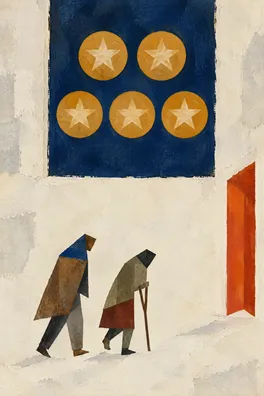
Five of Pentacles
Upright
The Five of Pentacles upright in A small next step directs attention to a real condition that may be restricting access. Time, fees, equipment, language or the sense of being an outsider can make learning harder before effort even enters the picture. The card’s hardship and exclusion should not be reduced to a lack of confidence. Some barriers need material support.
Name the single essential condition most in need of attention today. If a resource is missing, ask a library, course organizer, community group or other relevant support channel what is available. If you do not know where to begin, request the name of the appropriate person. A specific inquiry is more manageable than trying to solve every obstacle before allowing yourself to participate.
Help may be limited or difficult to access; the card does not promise that the first request will succeed. Record the answer and identify the next realistic route, including a smaller or lower-cost way to begin if suitable. Receiving support need not prove dependence, just as struggling without it does not prove a lack of ability. Notice what changes when the obstacle is described accurately.
The Page of Swords offers the energy to investigate, the Page of Cups reversed asks you to untangle feedback from wounded expectation, and the Five of Pentacles brings access and resources into the picture. Together they suggest that learning opens when curiosity, emotional needs and practical conditions receive different kinds of attention. More information cannot always solve the need for encouragement, and encouragement cannot replace missing equipment or time.
This week, select one modest learning question and one accessible original source or demonstration. After trying it, write what you understood, what happened emotionally and what practical obstacle remains. Seek one precise piece of feedback or one available resource based on that distinction. You are building a route back to the task after difficulty, rather than proving that difficulty never affects you.
If you can explain more but still feel excluded, look at the learning environment and support available. If resources are adequate but you keep avoiding corrections, make feedback smaller and more specific. Either adjustment can preserve curiosity without denying discomfort. What would you ask for if needing help carried no verdict about your capacity to learn?
A question to take with you
Is your next opening a clearer question, a more specific request for feedback, or practical help with a barrier you have been trying to carry alone?