
Pick a group
Choose a group: self-trust, open learning or gentle courage
Three readings explore how to rebuild judgment after a shaken assumption, learn without performing certainty, and make room for a small act of courage. Choose the question that feels useful today.
· AI-assisted readings from randomly drawn cards. For reflection and entertainment.
Take a breath. Pick the group that draws you in.
Group 1
Group 1
Trusting yourself
What can help me listen to my own judgment?
01Where you are

The Tower
Upright
The upright Tower in Where you are describes a foundation becoming impossible to ignore. In a reading about self-trust, this may fit the unsettling moment when a rule you relied on stops explaining what is happening. Perhaps a plan changes suddenly, or feedback exposes a gap between what you expected and what you can actually sustain. The card does not announce a coming disaster; it offers language for the disorientation of revising a belief.
A shaken assumption can become “I cannot trust any judgment I make.” That conclusion reaches further than the evidence. You might have made a reasonable choice with incomplete information, or continued a commitment after conditions changed. Distinguishing those possibilities matters because they ask for different responses: better information in one case, a clearer review point in the other.
Choose one important commitment and look at its backup plan. Identify a person to contact, a resource you still have and a step that can be reversed. Do not dismantle everything simply because one part feels unstable. If nothing has actually changed outside you, the alternative reading may be an internal belief being questioned rather than a crisis requiring action. Notice what remains dependable after you name the specific uncertainty.
02What needs attention
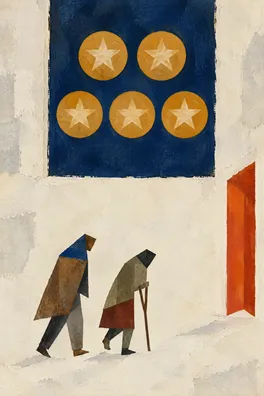
Five of Pentacles
Upright
The upright Five of Pentacles places scarcity and exclusion in What needs attention. Self-trust can become much harder when basic needs compete for attention or when asking for help feels like evidence of failure. This position suggests examining the conditions under which you are trying to think, rather than demanding flawless confidence from someone who is stretched thin.
If money, transport or time is tight, an apparently simple decision may carry a real cost. Advice that ignores that cost can leave you feeling more isolated. Name one essential condition that needs attention today: a workable payment timetable, access to a service, or practical help with a task. Then identify a specific support channel and what you could ask it to do. Availability is not guaranteed, so a second option may matter.
The blind spot is assuming that support exists in an accessible form merely because someone says it does. Check eligibility, timing and effort, and avoid blaming yourself if the first route does not work. Equally, do not let anticipated embarrassment answer every request before it is made. After one contact, notice whether the problem became more manageable or simply more clearly defined. Both can improve the basis for your judgment.
03A small next step

Page of Cups
Reversed
The Page of Cups reversed offers A small next step through separating an event from the meaning attached to it. The card’s concerns include disappointment, dependence and emotional expression that struggles to find a workable form. Here the task is not to dismiss feeling. It is to keep a hurt feeling from becoming the sole witness in a case against your own judgment.
Suppose someone has not replied to a request. The event is that a reply has not arrived; “my request was foolish” is an interpretation. You may need practical information, reassurance or time to understand why the silence matters so much. Write those needs separately before deciding whether to follow up. This protects the other person’s freedom without requiring you to pretend you are unaffected.
A small response could be one clear message with a realistic deadline, followed by a plan you can use without that reply. If the request was genuinely unclear, revise it; if you are seeking repeated reassurance, try naming the feeling privately first. The reversed Page also warns against treating an imagined connection or promise as an established agreement. Look for what has actually been said and done, and let that evidence support your next judgment.
These cards make self-trust a process of rebuilding conditions for judgment. The Tower exposes an assumption, the Five of Pentacles asks whether you have enough practical support, and the reversed Page of Cups helps distinguish emotional meaning from observable events. None requires you to become certain before you can take care of yourself. Together they suggest that confidence becomes more credible when it rests on specific observations and usable resources.
There is another possibility worth keeping open: the central issue may be a difficult external arrangement rather than a lack of trust in yourself. If a commitment repeatedly leaves you without essential resources, better self-talk will not repair its terms. Review what needs renegotiation and what evidence you have about the other party’s actual commitments, without assuming you know their intentions.
This week, try one brief decision record for a modest choice. Note what you knew, which resource you needed and what you expected to learn. Arrange a backup before acting, then revisit the record after the outcome. Judge the quality of your process separately from whether the result pleased you. If recording becomes a way to prosecute every small mistake, reduce the exercise to one decision and include what you handled well. What remains trustworthy in you when a particular assumption turns out to be wrong?
A question to take with you
What specific fact, resource or boundary would help me hear my judgment more clearly than another round of reassurance?
Group 2
Group 2
Learning
What approach could make learning feel more open?
01Where you are

The Magician
Reversed
The Magician reversed in Where you are raises a question about the distance between appearing capable and being prepared. In learning, scattered intentions or unused abilities can make a subject feel mysteriously inaccessible. You may have collected tools, courses and plans without defining the skill you want to practice. Another possibility is that a confident explanation has encouraged you to overlook missing foundations.
Consider the difference between recognizing a demonstration and reproducing it yourself. A polished video or fluent instructor can make understanding feel complete before you have tested it. That does not establish deception, but the card’s warning about exaggerated claims invites you to check a promise against evidence. What is actually taught, which prerequisites are assumed, and what can a beginner reasonably accomplish?
Choose one small task that reveals your present level without requiring a performance. Try a short explanation in your own words or complete one basic exercise with the instructions closed. Record the point where you become uncertain. The useful outcome is a clearer starting place. If you already have the skill but keep avoiding practice, the issue may be focus rather than inadequacy; reduce competing tools instead of buying another solution.
02What needs attention

Queen of Wands
Upright
The upright Queen of Wands brings independent enthusiasm to What needs attention. Alongside the reversed Magician, she suggests restoring a reason to learn that belongs to you. Competence can grow from interest and expression, rather than from protecting an image of being naturally talented. Confidence here means being willing to participate with a real question.
Perhaps you want to learn a language for a conversation, drawing to describe a place, or a technical skill to solve a small problem. State that aim in a learning conversation, and ask what the other person wants too. A study partner may enjoy experimentation while you want correction; naming both preferences can prevent a useful relationship from becoming a silent contest.
The Queen’s charisma also has a blind spot: a lively session can feel successful even if the central confusion remains untouched. Give enthusiasm a concrete object. Bring one example, ask one question you actually care about, and try the answer in practice. If a group makes you perform confidence rather than explore, a quieter setting may serve your interest better. Authentic expression does not require constant sociability.
03A small next step

Nine of Wands
Reversed
The Nine of Wands reversed makes A small next step an examination of defenses and fatigue. Past criticism can turn every new exercise into another test you expect to fail. Alternatively, you may simply be tired after sustained effort. The reversal can also describe beginning to lower your guard; it does not insist that persistence is always the right response.
Tell a trusted teacher or peer one specific thing you have been bracing for alone. You might say, “I stop asking questions when I think they sound basic; could you help me locate the missing step?” Ask for practical advice rather than a verdict on whether you are talented. The request creates a way to receive help without surrendering your own assessment.
If the response is dismissive or the setting repeatedly punishes honest questions, lowering your guard further may be unhelpful. Change the setting, the pace or the person you ask. If exhaustion is the obstacle, a shorter session with recovery can teach you more than another strained hour. Notice whether the next attempt brings curiosity back, or whether you are continuing mainly to avoid admitting that the present method has stopped working.
This group moves from performance toward a more honest learning relationship. The reversed Magician checks preparation and promises; the Queen of Wands restores personal interest; the reversed Nine of Wands asks which defenses or demands have made exploration costly. Their shared invitation is to make a gap in knowledge useful rather than shameful. That requires both an accurate starting point and a setting where questions can receive practical answers.
The tension is that enthusiasm alone cannot replace foundations, while endless preparation can become another way to postpone participation. You might need a prerequisite exercise, or you might already be ready to try something small. Let a concrete attempt tell you which explanation fits instead of deciding from the feeling of confidence or fear alone.
Over the next week, choose one task small enough to repeat twice. Before the first attempt, write why it matters to you. After it, name one missing step and seek specific help. Leave a recovery interval before trying again, then compare what became clearer rather than scoring your overall worth. If the task remains opaque, make it smaller or change the explanation; if it is too easy, add one meaningful challenge. What would you be willing to ask if you did not have to sound knowledgeable first?
A question to take with you
Where am I protecting the appearance of competence when a specific question would help me learn?
Group 3
Group 3
Everyday courage
What might a gentle act of courage look like today?
01Where you are

Two of Pentacles
Reversed
The Two of Pentacles reversed in Where you are points toward an arrangement carrying more demands than it can balance. Everyday courage may begin by acknowledging that time, money and attention have limits. The issue need not be a dramatic failure; a timetable that once worked can become unworkable when one responsibility changes.
Imagine accepting another small favor because each request seems reasonable in isolation. The combined cost may leave essentials squeezed into the edges of the day. Rather than asking whether you should be able to cope, list what each commitment actually requires, including travel, preparation and recovery. This makes the overload concrete enough to discuss.
Choose one minor arrangement to cancel, postpone or hand over, and communicate the revised timetable to anyone affected. A clear message can feel more courageous than silently trying harder. The alternative reading is poor allocation rather than too much work overall: perhaps a recurring task can move to a better time. Notice which change restores care for an essential responsibility, rather than merely making the calendar look tidier.
02What needs attention

Temperance
Upright
Temperance upright in What needs attention emphasizes gradual integration and a pace that can continue. Beside the reversed Two of Pentacles, it asks how to bring competing needs into a workable whole. This is more specific than a general instruction to relax. It may involve changing the length of a work session, making room for recovery, or adjusting expectations with another person.
If you tend to swing between an intense burst and complete withdrawal, try ending a session while you still have enough energy to return. Schedule a proper break and decide what will mark the next beginning. This links rest to continuity rather than making it a reward that is repeatedly deferred. You can observe whether the new rhythm improves attention and reduces the dread of starting.
Temperance can be misread as accepting every compromise. Some demands cannot be blended fairly, and a boundary may be necessary before balance becomes possible. If your adjustment simply absorbs another person’s unreasonable timetable, revisit the agreement itself. Gentle courage can include an honest statement of capacity, offered early enough that a different arrangement can be made.
03A small next step

The Chariot
Upright
The upright Chariot in A small next step gives direction to that adjusted pace. Its meaning is the harnessing of opposing forces through clear intention and self-control. In a gentle-courage reading, progress does not need to look forceful. It can mean keeping one chosen aim in view while the impulse to please everyone pulls another way.
Define what completion looks like for today: send a necessary message, finish one part of a task, or attend a conversation with your main point written down. Remove one unnecessary step that serves appearance more than the goal. Then give the remaining action a beginning and an end, so determination does not become an unlimited demand on yourself.
The Chariot’s blind spot is treating every obstacle as a contest to win. Other people have their own constraints, and a setback may call for a changed route rather than greater force. After the small action, ask whether it moved you closer to what matters or simply kept you busy. If the destination no longer fits, revising it can be an expression of self-direction too.
This group makes room for courage by reducing conflict between capacity and intention. The reversed Two of Pentacles names the overload, Temperance builds a sustainable rhythm, and the Chariot directs the energy that becomes available. Taken together, they suggest that a smaller commitment carried through can express more resolve than a crowded plan that depends on ignoring your limits.
The cards also challenge one another. Balance without direction can become endless rearranging, while direction without moderation can recreate the original overload. Your useful adjustment lies where a clear priority meets a realistic pace. If the pressure comes mainly from external demands, communicate the change; if it comes from your own unnecessary standards, experiment with a simpler definition of done.
For the coming week, choose one recurring responsibility. Remove or postpone a minor demand, shorten one work period and decide in advance what completion means. After a few attempts, note whether you have more reliable attention and whether the arrangement is fair to those involved. If work merely spills into the break, reduce the task or renegotiate the deadline. If the pace feels sustainable, keep it long enough to learn from it before adding more. What becomes possible when courage includes deciding what you will not carry today?
A question to take with you
Which manageable action would move me toward what matters, and which demand can I set aside to make room for it?