
Pick a group
Choose a group: steadiness, belonging or a meaningful small step
Three personal readings explore a quiet transition, a more supportive sense of home and a routine that may be ready to change.
· AI-assisted readings from randomly drawn cards. For reflection and entertainment.
Take a breath. Pick the group that draws you in.
Group 1
Group 1
A change of season
How can I meet a transition with more steadiness?
01Where you are

The High Priestess
Upright
The upright High Priestess in Where you are suggests a transition whose meaning is still taking shape. Her association with intuition and knowledge not yet brought to light makes quiet observation useful here. You may notice that an old schedule feels wrong before you can explain what should replace it. That feeling can be a starting point for inquiry without becoming a command to make an immediate change.
A concrete situation might be entering a new role while still feeling attached to the competence of the old one. Other people may ask for an enthusiastic account before you have one. Give yourself a private place to record what feels energizing, what feels draining and what remains unknown. Repeated observations can help distinguish a durable preference from the strain of a difficult day.
The blind spot is treating silence as evidence of a hidden truth. This card cannot tell you what another person intends, and an intuition can be shaped by fear or incomplete information. Write down one feeling you have not voiced, then identify a gentle way to check the practical part of it. If you sense that your workload is unsustainable, an actual conversation about priorities may reveal more than another evening spent interpreting the feeling alone.
02What needs attention

Six of Wands
Reversed
The reversed Six of Wands in What needs attention brings recognition and confidence into the transition. A change can remove familiar signs that you are doing well: quick praise, visible expertise or a clear place in a group. Their absence may feel like defeat even when you are simply learning in a new setting. The reversal asks how much your sense of progress depends on an audience.
If you are a beginner again, compare today’s work with an appropriate learning goal rather than with your strongest performance in the previous season. Perhaps success this week means asking a clear question or completing one task without exhausting yourself. Define that criterion before looking for approval. This does not make unseen effort automatically effective; it gives you a fairer basis for assessing it.
An alternative is that recognition really is missing from an environment where support matters. Private standards should not become an excuse to accept chronic neglect or avoid useful feedback. Notice whether the problem is needing applause for every step, or lacking the information and acknowledgment required to learn. You can seek a specific review of your work while keeping your worth separate from the response.
03A small next step

Temperance
Upright
Upright Temperance in A small next step offers gradual integration rather than a dramatic new identity. A transition often requires old skills and new demands to coexist for a while. Moderation here is active adjustment: finding a pace that lets you notice what works, recover from effort and try again. Balance may look different from one day to the next.
Choose one work period or recurring obligation and make its length more realistic. Place a genuine break beside it, then observe your attention afterwards. If you have been trying to recreate your old productivity immediately, a shorter session may reveal a sustainable rhythm. If you have become hesitant to begin at all, the same bounded session can provide a gentle structure.
Temperance does not require endless patience with a setup that remains harmful or unworkable. Its integration depends on the ingredients being adjustable. If a small change leaves the same strain intact, ask which demand needs renegotiation or outside help. The experiment succeeds when it teaches you something about your pace, even if the first adjustment is not the right one.
These cards describe steadiness as an unfolding relationship with change. The High Priestess makes room for what you have sensed but cannot yet explain. The reversed Six of Wands shows how a lack of recognition can rush that process, tempting you to perform certainty. Temperance brings the reading back to a pace at which an honest response can develop.
For the coming week, keep a short private note after one recurring activity: what did you notice, what did you actually complete, and what helped you recover? Choose a completion criterion that belongs to this season, then try one modest change in timing. At the week’s end, look for a pattern rather than a verdict about your character. If the notes show persistent overload, adjust the demand or ask for practical support instead of requiring greater composure from yourself.
There is another possible story: your direction may already be clear, while fear of losing approval keeps you waiting for more certainty. In that case, quiet observation has done its job and a small conversation may be the next act of balance. What would count as steady progress if nobody were available to applaud it this week?
A question to take with you
Which part of this transition needs quiet attention, and which part needs a practical adjustment I can make now?
Group 2
Group 2
Home and belonging
What would make my sense of home feel more supportive?
01Where you are

The Hierophant
Upright
The upright Hierophant in Where you are brings shared values, tradition and learning from others into the meaning of home. Belonging may be sustained by an ordinary ritual: a meal, a regular call, a familiar place or a community that knows your name. Its support comes partly from not having to invent every form of care alone.
This can matter when you are rebuilding a household rhythm or living somewhere that still feels temporary. Ask which inherited practice gives you actual comfort and which you follow only because it has always been expected. You might keep the weekly gathering while changing its length, or seek a mentor’s advice on building community after a move. A specific question makes experience easier to share than a general request to explain how to belong.
The card’s respect for convention has a limit: recognition by a group is not the same as feeling safe or able to be yourself within it. A tradition can provide structure and still need revision. Notice whether you can disagree, ask for help or rest without earning your place again. Supportive belonging should have room for participation that fits your circumstances.
02What needs attention

Eight of Swords
Reversed
The reversed Eight of Swords in What needs attention suggests a constraint beginning to loosen. In a reading about home, the change may be a newly visible choice about space, contact or expectations. You may have assumed that a routine was fixed, then discovered that one part can be negotiated. The reversal focuses on recovering agency without pretending every limit has disappeared.
For example, a person sharing a crowded home may not be able to move, but might be able to request a predictable quiet period. Someone who feels obliged to attend every family event may be able to choose a shorter visit. Write down the smallest choice that is genuinely available, and the support it would require. A practical option is more useful than blaming yourself for not feeling free enough.
The blind spot is mistaking a new perspective for a complete solution. Money, housing access and other people’s needs can impose real constraints. If your first request is not possible, the insight may still be valuable: it identifies what matters and where help is needed. Let a trusted person assist with mapping alternatives rather than turning the reversal into pressure to solve everything alone.
03A small next step
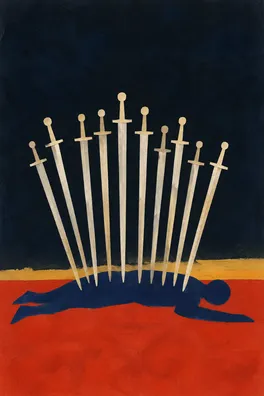
Ten of Swords
Reversed
The reversed Ten of Swords in A small next step points toward recovery after a painful ending. Within this position, the beginning can be very modest: one rule that prevents an old difficulty from taking over the present. The card’s recovery theme does not establish that your hardest phase has ended. It asks what would make a restart more sustainable if you are ready for one.
You might notice that an old disagreement returns whenever everyone is tired, or that you offer more hospitality than you can comfortably sustain. Choose one enforceable boundary, such as postponing a difficult discussion until an agreed time or setting a clear end to a visit. State what you can do rather than making a rule that depends entirely on another person’s cooperation.
Lingering pain may make a reasonable boundary feel like rejection, to you or to someone else. Give the adjustment time to become familiar and explain its purpose where that is useful. Recovery does not require restoring the previous arrangement. If the boundary repeatedly fails, seek additional support or revise the arrangement; repeating an exhausted promise is unlikely to make a home more supportive.
The Hierophant offers a structure for belonging, the reversed Eight of Swords asks where that structure has room to change, and the reversed Ten of Swords asks how change can protect recovery. Together they suggest that home can become more supportive through selective continuity: keeping what nourishes you while revising what recreates strain.
This week, choose one ritual worth keeping and one expectation worth renegotiating. Ask an experienced or trusted person a concrete question about the latter. Then try one small boundary or request and notice its effect on your energy, access to rest and willingness to participate. Measure the experiment by whether support becomes more workable, not by whether everyone approves immediately.
An alternative explanation is that a familiar custom feels restrictive because its purpose has become unclear. A conversation may restore its meaning without requiring its removal. Equally, a custom’s history does not obligate you to repeat harm. Let what happens during the experiment inform the next step. What could you preserve from your idea of home while giving yourself more room to live within it?
A question to take with you
What small choice or boundary would help belonging feel more supportive and less conditional?
Group 3
Group 3
Your next small step
Where could one small, realistic step make a difference?
01Where you are

King of Cups
Reversed
The reversed King of Cups in Where you are raises the possibility of feeling being suppressed, overflowing or carried indirectly through a relationship. In the context of a small next step, it directs attention toward how a need is expressed. Irritation can become a cold answer; uncertainty can become a demand that someone else provide reassurance. This is a pattern to consider, not a diagnosis or evidence of anyone’s motives.
If a delayed reply has left you unsettled, notice the difference between asking for clarity and making another person responsible for ending all discomfort. Try translating a blaming sentence into a feeling and a specific request: “I feel uncertain about our plan; could we confirm a time?” The request gives the other person something concrete to answer while leaving you responsible for how you manage the waiting.
The alternative is that your concern points to an actual unmet agreement. Owning your feelings does not require minimizing unreliable behavior or accepting manipulation. Describe what happened plainly and decide what boundary is within your control. A manageable first step can be to draft the message, pause, and check whether it asks for something realistic rather than trying to secure a guarantee of emotional safety.
02What needs attention

Knight of Pentacles
Reversed
The reversed Knight of Pentacles in What needs attention points to a routine that consumes effort without producing enough movement. Its stagnation can arise from stubbornness, avoidance or caution that has outlived its usefulness. Here the important question is what the method accomplishes, rather than whether you appear disciplined while repeating it.
Perhaps you keep reorganizing a task list instead of starting the difficult item, or insist on a detailed preparation ritual before a short conversation. Choose one step that takes substantial energy for little return and simplify it once. Send the essential question without perfecting the surrounding explanation, or begin with the material already available. Observe whether progress becomes easier and whether anything important was actually lost.
The reversed Knight should not turn fatigue into a moral failing. A routine may be stalled because the task is too large, the instructions are unclear or your available energy is limited. In that case, reducing scope or asking for clarification is more appropriate than pushing harder. The useful distinction is between a method that protects quality and one that protects you from the discomfort of beginning.
03A small next step

Eight of Cups
Upright
The upright Eight of Cups in A small next step brings the possibility of moving away from something that no longer provides fulfillment. In this position, departure need not mean an immediate major exit. It may be a modest shift of time or attention toward a value that has been missing. Past effort can remain meaningful even when it no longer determines your next choice.
Write down the part you want to leave and the value you want to approach. If you want to leave constant availability, the value may be focused attention; the experiment could be one protected hour. If you want to leave a perfectionistic routine, the value may be useful participation; the experiment could be sharing a workable first version. Name both sides so that relief from discomfort is not your only measure of direction.
There is a blind spot in walking away too quickly: disappointment may belong to a temporary obstacle rather than a fundamental mismatch. Where a conversation or a short trial could resolve the uncertainty, give it a fair chance. Where the gap remains clear, allow a reversible adjustment to teach you more. The card invites a meaningful movement, with room to reflect on what you gain and what you miss.
The reversed King of Cups asks for a more direct relationship with feeling. The reversed Knight of Pentacles asks whether the current method still serves you. The Eight of Cups connects both questions to direction: a small step becomes useful when it moves toward a chosen value rather than simply discharging tension.
For the coming week, pair one clear request with one simplified routine. Write the request before sending it, remove a low-value preparation step, and use the time recovered for a small activity connected to the value you named. Afterward, note whether communication became clearer and whether the change created meaningful movement. If it only shifted pressure onto another person, revise the request. If simplification removed something essential, restore that part while keeping the rest lighter.
Another interpretation may fit better if you already communicate plainly and your routine is sensible: the task itself may no longer deserve the same investment. Then the experiment is a limited change of commitment, with its consequences made explicit. You do not need to declare the past a mistake to choose a different next step. What are you ready to stop repeating, and what would make the space you recover worth having?
A question to take with you
What am I moving toward, and which small change would let me practice that value this week?