
Pick a group
A chapter, a small step, or a little more room
Choose the group whose question meets you today: returning to unfinished work, finding a realistic next step, or putting down a burden that has crowded out your own energy.
· AI-assisted readings from randomly drawn cards. For reflection and entertainment.
Take a breath. Pick the group that draws you in.
Group 1
Group 1
An unfinished chapter
How can I approach something I have left unfinished?
01Where you are
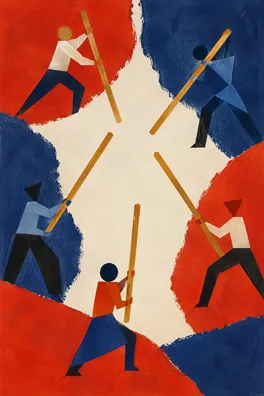
Five of Wands
Reversed
The reversed Five of Wands in Where you are suggests that the unfinished chapter may have become quieter without becoming clear. Its meaning includes tensions easing, compromise or leaving a contest, but also conflict pushed out of sight. Perhaps you stopped a shared project because every conversation became an argument about whose method was best. The absence of messages may feel peaceful even while the task still occupies your attention.
There is another possibility: stepping away was a good decision, and the unfinished feeling comes from an expectation that everything must be completed. Distinguish unfinished work you still value from a competition you no longer want to enter. The card cannot tell you which applies. Notice whether you want the actual result, an apology, or simply freedom from the discomfort of an open ending.
Turn the old disagreement into one discussable question, such as whether the remaining work still serves a shared purpose. Write it privately first if contact would be premature. You do not need to reopen every argument to establish the status of one task. Watch for resentment returning through sarcasm or overexplaining; that may mean the emotional issue needs a separate conversation from the practical work.
02What needs attention

Two of Swords
Upright
The upright Two of Swords in What needs attention brings the effort of maintaining a standoff into view. Keeping two options suspended can protect you from an immediate cost, yet it also consumes attention. You might be choosing between finishing a course and admitting that it no longer fits, or between repairing a collaboration and completing your contribution independently. Outward stillness can conceal considerable work.
Make two short descriptions of the options. For each, name one need it protects and one unknown that genuinely changes the decision. If the unknown is whether a collaborator can contribute, ask about capacity rather than interpreting silence as rejection. If you already know the practical facts but keep seeking another opinion, the missing piece may be willingness to accept disappointment rather than information.
A temporary pause can be wise when an answer is due soon or your capacity is unusually limited. Give that pause a purpose and a review date so that it does not quietly become permanent. You may also discover a third option, such as a smaller finish or a clear closure. The aim is to bring feelings and facts into the same decision, without forcing certainty they cannot provide.
03A small next step

Six of Pentacles
Reversed
The reversed Six of Pentacles in A small next step asks you to examine the terms of giving and receiving around this unfinished matter. Its meaning concerns unequal exchange, withheld help or assistance with strings attached. This does not establish that another person is controlling you. It asks whether the arrangement leaves you free to name limits, decline an extra request and describe what you can actually provide.
Suppose someone offered help with an application, but you now feel obliged to take on unrelated work in return. Or you may have promised support so broadly that the original task became impossible. A manageable step is to state the remaining scope: what is needed, who can do it and what is outside the agreement. Gratitude can be real while the terms still need revision.
If the imbalance comes from assumptions rather than an explicit demand, seek clarification before assigning blame. If speaking directly has previously led to pressure, begin by writing your boundary and consulting someone you trust. Completion is not worth an unlimited debt of time or goodwill. Notice whether clearer terms make the task feel more possible, or reveal that a respectful ending is the better use of your energy.
This group moves from quiet conflict to a suspended choice and then to the practical terms of exchange. Together, the cards suggest that the unfinished chapter may need a clearer agreement before it needs more effort. Pushing yourself to work harder could repeat the problem if the purpose, decision or responsibilities remain unresolved.
There is room for a less relational explanation: you may simply be tired or missing a necessary resource. In that case, do not manufacture a hidden dispute. Use the same sequence gently: identify what still matters, find the one unknown that blocks progress, and specify the help you can accept. The reading is useful when it makes the situation more concrete, not when it supplies a dramatic story.
This week, choose one unfinished item and spend a short session describing a modest definition of done. Then make one bounded request or clarify one responsibility. Review whether the response reduces uncertainty and whether the proposed exchange feels workable. If neither happens, adjust the scope or consider an explicit closure rather than treating continued delay as a personal failure. An ending can be a deliberate decision as well as a completed product.
A question to take with you
What would a fair, manageable ending to this chapter look like, even if it differs from the finish I first imagined?
Group 2
Group 2
Your next small step
Where could one small, realistic step make a difference?
01Where you are

The Devil
Upright
The upright Devil in Where you are names the way attraction or dependency can narrow your sense of choice. Its meaning includes material attachment, possessiveness and unequal power. In this personal reading, that might appear as checking for approval before beginning work, agreeing to every request to preserve access to an opportunity, or reaching for a familiar distraction when a task feels exposing. These are possible situations, not a diagnosis.
The immediate reward often explains why the pattern persists. Refreshing a message feed may briefly ease uncertainty; overcommitting may bring a moment of praise. Calling yourself weak adds another burden without changing the conditions. Ask what the habit gives you, what it costs later and which part you can influence today. A real external constraint should be acknowledged rather than dismissed as a mindset problem.
Choose a boundary small enough to observe: one work interval before checking messages, one evening without accepting new requests, or a written limit on a recurring favor. The point is to discover a little room for choice. If the boundary is unrealistic, make it smaller or seek support; the card’s difficult symbolism need not become a demand for a dramatic break.
02What needs attention

Three of Pentacles
Upright
The upright Three of Pentacles in What needs attention brings skill, collaboration and shared standards into the reading. It counters the assumption that freedom requires doing everything alone. If you have been caught in repeated effort without progress, the missing ingredient may be a specific piece of knowledge, useful feedback or agreement about what a good result looks like.
Share a small sample rather than a sweeping promise. A paragraph, sketch, budget outline or practice attempt gives an experienced person something concrete to respond to. Ask one focused question, then agree on who will do what next. This makes assistance observable and reduces the risk of relying on praise that feels good but provides no direction.
Collaboration has a blind spot when it becomes another way to seek permission. You can learn from someone’s skill without giving them ownership of every decision. Clarify which standard is necessary for the task and which preference belongs to the reviewer. If no collaborator is available, use an established example and compare one feature at a time; the next step can still be informed rather than isolated.
03A small next step

Three of Swords
Reversed
The reversed Three of Swords in A small next step suggests pain beginning to ease through recovery and letting go. It can allow apology or reconciliation, but it does not require a relationship or project to return to its former shape. A realistic step may be to stop using an old disappointment as a verdict on your present ability.
Write the thought that keeps circling back, such as the belief that one rejected attempt proves you should never show your work again. Separate the event from your interpretation and from the need beneath it. The event might be a refusal; the interpretation might be that everyone will refuse; the need might be clearer feedback or a safer first audience. Each calls for a different response.
Choose one change that makes today easier: revise a small section, ask for a specific comment or put an upsetting exchange away for the evening. If the feeling remains, the step has not necessarily failed. Healing can be gradual, and you do not owe anyone forgiveness on a schedule. Notice whether you are allowing more choices than the old story permitted, rather than demanding that all hurt disappear first.
The sequence here is constraint, shared craft and recovery. The Devil describes a pattern that can feel compulsory; the Three of Pentacles offers practical help and standards; the reversed Three of Swords makes room to act without carrying every earlier disappointment as an identity. Together they favor a supported, observable experiment over a grand promise to become a different person.
A useful distinction is between discomfort caused by learning and an arrangement that repeatedly costs you freedom. Feedback may feel uncomfortable while still being respectful and useful. Approval that requires unlimited availability may feel comforting while keeping you stuck. Look at the terms and effects of the exchange, and allow your interpretation to change with what actually happens.
For the coming week, pair one small boundary with one small piece of shared work. Protect a brief interval, make a sample and ask one person a precise question. Afterwards, record what helped, what felt pressuring and what you would change. If the request is too exposing, reduce the sample or choose a different audience. The experiment is worthwhile when it increases agency and understanding, even if the finished result remains some distance away.
A question to take with you
What small boundary and specific form of help would give me more choice without asking me to feel completely ready?
Group 3
Group 3
Making space
What could I put down to make a little more room?
01Where you are

Queen of Wands
Reversed
The reversed Queen of Wands in Where you are turns attention toward confidence, enthusiasm and the strain of being seen. Her meaning includes insecurity, jealousy, irritability or fading energy. You might recognize a commitment accepted mainly to prove competence, followed by resentment when it takes time from something you care about. Or you may have withdrawn from an activity after comparing your progress with someone else’s.
These possibilities do not mean your passion is gone or that every difficult feeling is a character flaw. A person can enjoy the work and still be tired of performing confidence around it. Ask whether the drain comes from the activity, its audience or the number of obligations surrounding it. Different causes need different adjustments.
Identify one extra commitment you accepted primarily to demonstrate that you could handle it. Consider reducing or withdrawing it with clear notice. If that is not possible immediately, limit the additional work it generates. Notice whether the space restores interest or simply reveals a need for rest. The card’s blind spot would be treating every responsibility as an attack on freedom; keep the distinction between a chosen obligation and a performance you no longer wish to maintain.
02What needs attention

Eight of Wands
Reversed
The reversed Eight of Wands in What needs attention points to delay, scattered messages and haste that disrupts coordination. When progress slows, the instinct may be to answer faster and keep more conversations open. That can multiply ambiguity: two people act on different versions of a plan, while you spend the afternoon repairing misunderstandings.
Choose one delayed matter and gather its essentials into a single confirmation: the task, its owner, the next handoff and the due time. If you do not know one of these, label it as unresolved and ask the relevant person. A clear message may make more room than an additional hour of rushing because it reduces the work created by uncertainty.
Not every delay is a communication failure. Another person may lack capacity, a dependency may be outside everyone’s control, or the original timing may simply be unrealistic. In that case, revise the plan rather than polishing messages indefinitely. The useful question is whether speed would solve the problem or only conceal it for another day. Put down the demand to keep momentum visible at all costs.
03A small next step

The Hierophant
Upright
The upright Hierophant in A small next step offers established teaching, shared values and learning through a community or institution. After the strain of proving yourself and the confusion of scattered movement, a trusted structure may reduce the number of decisions you must invent alone. This could be an experienced mentor’s method, a class routine or an agreed practice within a team.
Ask an experienced person a specific question about the pressure you have identified. For instance, ask how they decide which requests to decline, or what minimum information they require before beginning a task. A usable answer gives you a standard to try, not a new obligation to impress the adviser. Choose a routine that serves your values and actual capacity.
Tradition can also preserve expectations that no longer fit. Check whether you understand the purpose of a rule before adopting it. If it helps only by making you seem more acceptable to others, it may reproduce the Queen’s strain. You can respect a teacher while adapting a practice. Notice whether the structure makes your week clearer and leaves room for your own judgment.
This group moves from the cost of maintaining an image through disrupted momentum toward the possibility of a useful shared structure. Making space may involve relinquishing the job of appearing endlessly capable. Once that performance eases, you can see whether the practical problem is too much work, unclear coordination or the absence of a reliable method.
The Hierophant does not cancel the Queen’s need for a personal relationship with enthusiasm. A routine is valuable when it protects energy for work you choose, and less helpful when it becomes another public measure of worth. Likewise, slowing down is not automatically restorative if the same confusing commitments remain. Pair the emotional adjustment with a concrete change in how work enters your week.
Try one week with one reduced commitment, one clear confirmation for a delayed task and one borrowed practice from a trusted source. Keep the practice simple enough to notice its effect. At the end of the week, ask whether there were fewer avoidable misunderstandings and more room for an activity you value. If the new routine adds administration without easing pressure, simplify or replace it. You are looking for a structure you can inhabit, not another role you have to perform.
A question to take with you
Which expectation could I release, and which chosen practice would help me use the space in a way that feels like my own?