
Pick a group
Choose a group: room to learn, begin or return
Three reflective paths explore protected curiosity, a realistic fresh start and a clearer approach to an unfinished chapter. Choose the question that meets you today.
· AI-assisted readings from randomly drawn cards. For reflection and entertainment.
Take a breath. Pick the group that draws you in.
Group 1
Group 1
Learning
What approach could make learning feel more open?
01Where you are
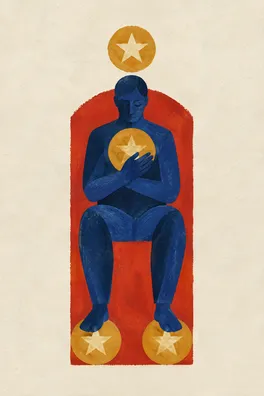
Four of Pentacles
Upright
The upright Four of Pentacles places security at the beginning of this reading. You may have a dependable routine, a limited study budget or a method that once helped you succeed. Holding onto these resources can be sensible. In Where you are, the card asks whether that structure now supports exploration or requires every unfamiliar idea to prove itself before you are willing to touch it. Openness becomes easier when your basic needs are protected, rather than when you demand unlimited flexibility of yourself.
Imagine learning a new tool while keeping your usual approach for time-sensitive work. You do not have to risk an important deadline to discover whether the tool helps. List what needs preserving—rest, essential expenses, a reliable reference—and reserve a small space for an experiment. The alternative reading is that your caution reflects real scarcity, not resistance. In that case, seeking a free resource or a smaller lesson may be wiser than criticizing yourself for being careful. Notice whether your structure leaves any room for surprise.
02What needs attention
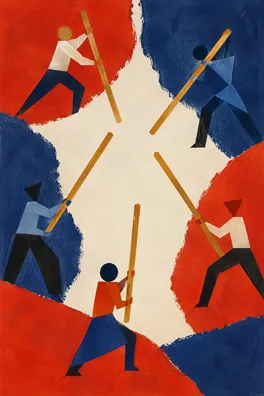
Five of Wands
Upright
The upright Five of Wands brings competing ideas and the desire for recognition into What needs attention. A class discussion, peer critique or disagreement between teachers can make learning feel like a contest over who is already competent. Yet friction can also reveal distinctions that a smooth explanation hides. The issue is whether different voices are helping you examine an idea or pulling you into a struggle to defend your place.
Before your next discussion, name the shared learning goal and agree on an order for speaking. If you are studying alone, give two competing explanations a fair hearing and compare where each works. You might discover that the disagreement concerns method rather than the result you want. A useful boundary is to ask for feedback about one observable feature of your work. You need not remain in an insulting exchange to prove that you welcome challenge. Productive disagreement should leave you with a clearer experiment, not only a ranking of people.
03A small next step
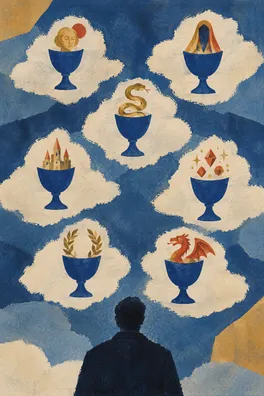
Seven of Cups
Upright
The upright Seven of Cups makes the next step a choice among possibilities. A shelf of courses or a growing list of tutorials may express real curiosity, but each option can also promise an imagined version of yourself who never struggles. In A small next step, the invitation is to bring one attractive possibility into contact with an ordinary constraint. That preserves imagination while allowing reality to participate.
Choose one resource and verify the practical detail most likely to matter: whether it teaches your actual skill level, fits a short weekly session or includes an exercise you can attempt. Then try the smallest complete lesson before collecting more options. If the choice feels dull after the initial excitement, ask whether the material is unsuitable or whether you have reached the normal effort of learning. Both are possible. Keep a brief note about what you could do afterwards that you could not do before; it offers firmer guidance than how impressive the course looked.
This group moves from protecting resources to sharing intellectual space and then testing a possibility. The Four of Pentacles gives curiosity a safe base. The Five of Wands allows that base to encounter other approaches. The Seven of Cups prevents possibility from remaining entirely imaginary. Together, they suggest that openness is a practice of manageable exposure, disagreement and verification, rather than a personality trait you either possess or lack.
For a week, keep one reliable study habit and add one modest experiment beside it. Ask someone to comment on a specific attempt, then use that feedback to choose what to practice next. If you find yourself gathering new resources whenever practice becomes uncomfortable, return to one exercise. If the experiment genuinely exceeds your time or resources, reduce its size instead of treating persistence as the only virtue. Your circumstances may require more security before more exploration.
At the end of the week, compare what you expected with what you actually learned. A useful outcome might be a clearer question, a discovered limitation or a more effective method; it need not be mastery. What could you protect well enough that you would feel free to be a beginner beside it?
A question to take with you
Which small learning experiment would stretch my method without threatening the resources I need to feel secure?
Group 2
Group 2
A fresh start
What is ready for a new beginning in my life?
01Where you are

Judgement
Reversed
Reversed Judgement in Where you are suggests that the beginning may be waiting beneath a harsh verdict. You might be turning a particular disappointment into an identity: because a previous attempt failed, you assume you are someone who cannot follow through. The reversal can also point to avoiding a lesson that needs attention. These are different possibilities, and honest reflection requires room for both. Self-condemnation and self-exemption can each keep a new start suspended.
Take one sentence you use against yourself and translate it into a change you could observe. If you say you always abandon projects, identify where the last one stopped and what support was missing. Choose when you will try a smaller version of that step. You do not have to declare yourself transformed. If the earlier decision caused a real problem, repair may belong in the beginning too. The aim is to answer a present need with a specific action, rather than to win a final judgment about your worth.
02What needs attention

King of Swords
Upright
The upright King of Swords brings clear criteria and fair judgment into What needs attention. After the uncertainty of reversed Judgement, a calm decision process can help you distinguish a meaningful fresh start from a reaction to shame. This card values reason and expertise, but it need not mean handing authority over to someone whose confidence is stronger than yours. A useful adviser should be able to explain the basis of a recommendation and acknowledge its limits.
Write the criteria a new arrangement needs to meet: available time, essential responsibilities and the kind of daily life you want to support. Apply them consistently to your preferred option and its alternatives. You could ask a knowledgeable person one focused question about a practical obstacle, rather than ask them to choose your life. The blind spot is making the criteria so rigid that no imperfect beginning can qualify. Include what you do not yet know, and name the evidence that would justify revising the plan.
03A small next step

Ten of Cups
Reversed
The reversed Ten of Cups places a mismatch between an ideal and real relationships in A small next step. A fresh start may require an honest conversation about support, expectations or values at home. This does not establish that a relationship is failing, nor reveal what anyone else secretly wants. It suggests considering whether the picture of a happy outcome has left too little room for the actual people whose routines would be affected.
Choose a calm moment to name one unspoken need and one concrete request. A change of study, work or personal routine might require protected time, a different division of tasks or simply permission to acknowledge disappointment. Ask what the other person can realistically offer and listen for differences without immediately forcing agreement. If your situation does not involve a close relationship, examine an inherited ideal of success that you still measure yourself against. The next step can be revising that picture so a workable beginning has somewhere to live.
The movement here is from a verdict to a decision and then to a conversation. Reversed Judgement shows how a beginning can stall when reflection becomes punishment or avoidance. The King of Swords offers standards that can be explained and revised. The reversed Ten of Cups brings those standards into daily relationships, where a plan needs practical support rather than a perfect story. A new beginning may therefore be a renegotiated way of living, not an entirely new identity.
This week, turn one condemning statement into a small change with a chosen starting time. Check that change against a few fair criteria, then discuss one need with anyone directly affected. If a conversation reveals less support than you expected, use that information to resize or reconsider the plan. If the criteria reveal that you are acting mainly to escape embarrassment, pause long enough to name what you actually want. Neither adjustment invalidates the wish to begin.
Review whether the experiment made your next action clearer and your expectations more realistic. Some beginnings need repair, some need permission you can give yourself, and some need an agreement with another person. Which of those needs belongs to your situation, once you set aside the demand that the beginning look impressive?
A question to take with you
What specific need could a fresh start answer if I stopped asking it to prove my worth or create a perfect life?
Group 3
Group 3
An unfinished chapter
How can I approach something I have left unfinished?
01Where you are

Queen of Swords
Reversed
The reversed Queen of Swords in Where you are asks whether an unfinished matter has become surrounded by a sharp story. You may describe yourself as lazy or another person as impossible, and those conclusions may now arrive before you examine the actual obstacle. The supplied meaning concerns bias, resentment and words that wound. It is an invitation to review the way you frame the matter, not a claim that your frustration is unjustified or that someone else means harm.
Replace one global judgment with an observable fact and a specific request. Instead of deciding that a collaboration was hopeless, you might note that one decision remained unanswered and ask whether it can still be made. If you are working alone, describe the unfinished task without an insult attached. This may reveal a need for a boundary, clearer scope or missing information. Softening a sentence does not require reopening an arrangement that no longer works; accuracy can support a firm ending as well as a renewed attempt.
02What needs attention

Six of Cups
Reversed
The reversed Six of Cups brings the past into What needs attention. An old project may still belong to an earlier role, relationship or version of success. Nostalgia can make you want the original plan intact, even though your life has changed. The reversal can also describe growing independence and a readiness to leave that plan behind. The question is whether memory is offering something useful or setting terms that the present cannot meet.
Identify the feeling you associate with finishing: belonging, competence, recognition or relief. Then ask whether the original task is still the right way to pursue it. A long-delayed creative project might fit a shorter format now; an old habit of working late might need replacing with a brief daytime session. Keep any part of the past that remains meaningful, while allowing the method to change. If you discover that the obligation itself has ended, acknowledging that can be more honest than preserving it as a permanent test you never take.
03A small next step

Ace of Swords
Reversed
The reversed Ace of Swords makes clarification the next step. Unfinished work often attracts a conclusion before the facts are clear: the opportunity is gone, a message would be unwelcome or the remaining task is impossibly large. In this position, the card asks you to turn a conclusion into a question that can be checked. Confusion does not have to be solved all at once, but it does need to be distinguished from certainty.
Choose one uncertainty you can safely investigate. Check the present requirements, make an inventory of what remains or draft a neutral question before deciding whether to send it. Where another person is involved, respect existing boundaries and do not treat a desire for closure as entitlement to a reply. You may find enough information to continue, change scope or close the chapter deliberately. If the answer remains unavailable, name the limit and choose what you can do without it. The goal is a clearer next action, not a forced resolution.
All three reversals direct attention to the conditions around the unfinished matter: a judgment that may have hardened, a past role that may no longer fit and a conclusion that may exceed the evidence. They do not require you to revive every abandoned task. The Queen of Swords asks for accurate language; the Six of Cups asks for a present-day relationship with the past; the Ace of Swords asks for one verifiable question. Together they make completion less about proving something and more about choosing with clearer information.
Set aside one short session this week to describe the matter without blame. Name what still matters to you, then check one uncertainty before choosing between resuming, reshaping or ending it. If resuming is appropriate, define a small piece that can actually be completed. If ending is appropriate, record the reason and tidy one practical loose end. If you cannot yet choose, identify the missing fact and when it would be reasonable to review it again.
Notice whether this process leaves you more capable of acting or merely produces another elaborate explanation for delay. You can reduce the exercise to a single question if reflection itself becomes avoidance. You can also slow down if contact, obligations or boundaries require more care. What would it mean to approach this chapter in a way that respects both who you were and what your life needs now?
A question to take with you
Which part of this unfinished matter is still alive for me, and which part survives mainly as an old judgment or an unchecked assumption?