
Pick a group
A place to belong, a steadier transition, an unfinished chapter
Choose the question that feels most useful today: making home more supportive, finding a sustainable pace through change, or returning to work you left unfinished.
· AI-assisted readings from randomly drawn cards. For reflection and entertainment.
Take a breath. Pick the group that draws you in.
Group 1
Group 1
Home and belonging
What would make my sense of home feel more supportive?
01Where you are

Page of Swords
Upright
The upright Page of Swords places curiosity at the beginning of this reading. In Where you are, it can describe noticing every detail of a living situation while still trying to understand what those details mean. Perhaps a shared room no longer offers enough quiet, or a new household has routines you have not yet learned. Alertness can help you identify a need, but it can also keep you mentally on duty when you want to rest.
Start with observations that another person could recognize: the kitchen stays noisy late, an agreement about chores is unclear, or you rarely spend time in the corner meant for relaxing. Separate these from conclusions such as “I do not belong here.” That feeling deserves care, but a specific observation gives you something workable to discuss. If home is already comfortable, the Page may instead invite fresh learning about what makes that comfort possible.
Choose one question to investigate directly, through a conversation or a simple look at your routine. Ask what is possible before assuming you know another person’s intentions. The Page’s blind spot is gathering more information forever. Once you have enough to name a modest need, let curiosity lead to a request rather than another private argument.
02What needs attention

Three of Wands
Reversed
The reversed Three of Wands brings delayed arrangements or insufficient support into What needs attention. Your picture of a supportive home may be waiting on something outside your control: a move, a repair, a reply from a housemate, or a promise of help. The reversal does not establish that an arrangement will fail. It asks whether the practical conditions match the expectations you have built around it.
Waiting can become especially tiring when the hoped-for change carries every possibility of relief. You may put off making the present space more livable because it feels temporary, or avoid following up because you fear hearing that support is unavailable. Check one pending arrangement and establish a realistic date for revisiting it. Be specific about what you need to know, rather than asking for a general assurance that everything will work out.
There may also be a simpler explanation: the plan is progressing slowly and needs ordinary coordination. Avoid treating a delay as a verdict on your worth or belonging. A temporary routine, a clearer division of tasks or one dependable contact can support you while larger conditions remain unsettled. Notice which part requires patience and which part needs an explicit agreement.
03A small next step

Three of Cups
Upright
The upright Three of Cups offers friendship and shared enjoyment as A small next step. After the Page’s careful observation and the reversed Three of Wands’ stalled expectations, this card suggests that belonging can grow through a small experience with other people. That need not involve hosting a gathering or making your home presentable. A short call, a walk with a friend or tea in a shared kitchen can be enough to make connection tangible.
Invite someone into a manageable exchange and leave room for their circumstances. You might share one small thing worth celebrating and ask about theirs. Mutual attention matters here: a supportive relationship gives both people room to be more than a problem to solve. If you live alone or far from familiar people, a recurring conversation can create continuity even when the physical setting cannot yet change.
The card’s blind spot would be treating sociability as the answer to every housing or household difficulty. Friendship cannot repair an unsafe arrangement or replace practical boundaries. Keep the scale honest: this step nurtures connection alongside the concrete issue you identified. Afterwards, notice whether you feel more at ease, more drained, or simply clearer about the kind of company you need.
This group moves from understanding your environment to checking what support is actually available, then creating a modest moment of connection. The Page of Swords and the Three of Cups complement each other: clear observation helps you ask for something specific, while friendship reminds you that home is also an experience of being welcomed. The reversed Three of Wands keeps the reading practical by asking what can happen now and what still depends on an unresolved arrangement.
Over the coming week, name one condition that would make home easier to inhabit. Follow up on the relevant agreement with a clear question and a review date. Alongside that, arrange one low-pressure contact with someone whose company usually allows you to relax. These are separate experiments; do not ask a friend to carry the whole weight of a housing problem, or make a logistical solution responsible for all your emotional needs.
If the contact feels tiring, reduce its length or try a different setting. If the practical problem remains unchanged, that is information about the arrangement and may call for a firmer request or another source of help. You do not have to manufacture gratitude for a situation that still needs work. What would help you feel more supported in the place and circumstances you actually have today?
A question to take with you
Which part of belonging could I strengthen through a clear agreement, and which part needs a small, mutual moment of connection?
Group 2
Group 2
A change of season
How can I meet a transition with more steadiness?
01Where you are

Ace of Swords
Reversed
The reversed Ace of Swords in Where you are suggests that the story of a transition may be arriving before the facts are clear. A changed role, a different daily rhythm or an ending can leave you wanting a decisive explanation. You might call the whole change a mistake because its first days feel awkward, or promise yourself that everything will improve once one milestone passes. Neither conclusion has to be settled today.
This reversal draws attention to judgment and language. When uncertainty is uncomfortable, a sharp statement can provide brief relief while making a conversation harder. Try turning “This will never work” into a question you can verify: which part of the new routine is failing, and under what conditions? If someone’s message seems ambiguous, ask about the practical detail rather than assuming disrespect or hidden intentions.
Sometimes the difficulty is not distorted thinking but genuinely incomplete information. In that case, identify what remains unknown and when you might reasonably learn more. You can make a provisional arrangement without pretending to understand the whole season. The useful shift is from demanding a final verdict to finding the next piece of clarity.
02What needs attention

Five of Cups
Reversed
The reversed Five of Cups, in What needs attention, brings the possibility of recovering from regret and reconnecting with support. A transition can be right for you and still involve loss. You may miss an old team, a familiar routine or the version of yourself that knew how to manage everything. Moving forward need not require making the past look unimportant.
Here the reversal invites you to notice whether support is becoming available, even if you have not yet known how to accept it. A person who asks how things are going may be able to offer company, practical help or a listening ear. Choose one kind of support you actually need and make the request small enough to answer. “Could you listen while I sort out the hardest part?” is clearer than hoping someone will guess what would help.
Recovery can also be confused with a demand to be cheerful. If you still feel sadness, that does not mean you are failing to adapt. The blind spot is using the promise of moving on to hurry past what matters. Give the loss a name, then notice one resource that remains. Both observations can be true without cancelling each other.
03A small next step

Temperance
Upright
Upright Temperance places patient integration in A small next step. Its balance is something practiced over time, as you combine old supports with new demands. Instead of rebuilding every routine at once, choose one work period or recurring task and make its pace more sustainable. A slightly shorter session followed by a real break may teach you more than a day of determined overextension.
For example, if a new schedule leaves you exhausted by evening, keep one familiar meal or wind-down habit while adjusting another part of the day. This is not a claim that a routine can solve every transition. It is a way to reduce the number of changes your attention must manage at the same time. Observe what helps you recover enough to return, rather than measuring only how much you completed.
Moderation should not become a rule that you must accept an unworkable demand halfway. Some situations require a clear boundary or a larger change. Begin with the manageable adjustment, then use its results as information. If the same strain returns despite a reasonable pace, reconsider the demand itself. Steadiness includes learning when a small adaptation is insufficient.
This reading traces a movement from an unclear story, through a more accepting relationship with loss, toward a pace that lets different parts of life fit together. The reversed Ace of Swords asks for less certainty in your conclusions. The reversed Five of Cups asks for more room to receive support. Temperance joins them by making adjustment a repeatable process rather than a single moment of resolve.
For one week, choose a transition-related task that has felt unusually difficult. Before beginning, name one fact and one unanswered question about it. Give the task a bounded period of attention and schedule a proper pause. On a separate occasion, ask a trusted person for one specific form of support. At the end of the week, compare your experience with the initial story you were telling yourself: did clearer information, kinder expectations or a different pace make the greatest difference?
If the practice becomes another demand to perform adaptation perfectly, simplify it to one observation and one pause. If new information reveals a deeper mismatch, you are allowed to reconsider the arrangement rather than merely tolerate it more gracefully. What would a steady transition look like if it could include uncertainty, grief and ordinary limits?
A question to take with you
What conclusion could I soften into a question, and what pace would let me keep learning through this change?
Group 3
Group 3
An unfinished chapter
How can I approach something I have left unfinished?
01Where you are

Six of Swords
Upright
The upright Six of Swords in Where you are describes moving away from difficulty while carrying what the experience taught you. Returning to unfinished work may therefore begin from a different shore. The project, course or conversation remains, but you may no longer have the same time, priorities or emotional relationship to it. That change is worth acknowledging before you recreate the original plan.
Ask what you want to leave behind and what conditions would make a return calmer. Perhaps the old approach involved an unrealistic deadline, repeated conflict or trying to manage everything alone. Bringing forward useful notes or lessons does not require bringing forward those conditions. Write a short list of what is still relevant, what can be set aside and who could help you navigate the next stage.
The card allows improvement to include sadness. You may be disappointed that the original version will not happen, even while a smaller version feels possible. Its blind spot would be calling every departure progress. If leaving the work untouched keeps the same difficulty in place, identify a concrete destination: a revised scope, a useful handoff or an intentional conclusion. Movement becomes meaningful when you know what it is moving toward.
02What needs attention

The Hierophant
Upright
The upright Hierophant brings teaching, established practice and shared values to What needs attention. An unfinished chapter may need a structure you do not have to invent: a course outline, a professional standard, a mentor’s experience or a community that understands the work. Asking an experienced person a precise question can reveal a path that solitary reflection has not supplied.
Prepare the question around a real obstacle. You might ask which section should come first, what counts as a sufficient draft, or how someone else approached a comparable difficulty. Explain the conditions you are working within so that the guidance can be relevant. A useful convention saves effort by holding some decisions steady; it can make returning feel less like negotiating the entire project again.
The Hierophant also asks you to distinguish chosen values from inherited obligation. Finishing something merely because you once said you would may no longer make sense, while a commitment to another person may deserve explicit renegotiation. Respect experience without making it unquestionable. If the advice assumes resources you do not have, adapt the structure or seek another perspective. Support should help you act with understanding, not replace your judgment.
03A small next step
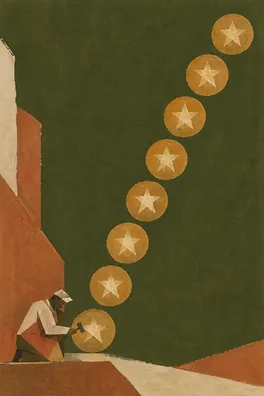
Eight of Pentacles
Upright
The upright Eight of Pentacles makes focused practice the small next step. After the Six of Swords changes the conditions and the Hierophant offers a usable structure, this card brings attention to one concrete detail you can improve. The aim is not to recover all the lost time. It is to make contact with the work in a way that produces a visible piece of learning.
Choose a short session with a specific unit: revise one paragraph, rehearse one passage, complete one exercise or repair one small part. Before starting, state what you are practicing and how you will notice improvement. Afterwards, compare the result with the previous attempt and record one useful change. This gives you a reason to return that is more reliable than waiting for a dramatic feeling of motivation.
Diligence has a shadow when careful work becomes endless polishing. Set a reasonable stopping point for the session and distinguish practice from completion. If a detail keeps consuming time without serving the project’s present purpose, ask whether the standard is appropriate. A sustainable craft grows through attention and adjustment; it does not require proving your worth through exhaustion.
These cards offer a sequence for returning without repeating the conditions that made the chapter difficult. The Six of Swords asks what should travel with you. The Hierophant asks which guidance and commitments still deserve your trust. The Eight of Pentacles asks what a workable return looks like at the level of an ordinary session. Together they favor a deliberate route over a promise to finish everything in one surge.
This week, choose one unfinished matter and describe its present purpose in a sentence. Decide whether you want to resume it, reduce its scope, hand it over or close it intentionally. If resuming fits, ask one experienced person a focused question and schedule a small practice session using the answer. Keep the evidence simple: a completed unit, one improvement and a note about the next obstacle.
If repeated sessions reveal that the purpose no longer matters, do not treat persistence as the only honorable outcome. If the purpose remains but the method fails, adjust the structure or ask for more relevant help. An intentional ending and a renewed commitment both require honesty about what you can sustain. What would count as a meaningful next chapter now, rather than repayment of an old promise to yourself?
A question to take with you
What deserves to come forward from this unfinished work, and what specific, limited practice would help me discover whether I still want to continue?