
Pick a group
Choose a group: the judgment, connection or work that needs your care
Three personal readings explore a quieter kind of self-trust, the freedom inside mutual support and the conditions a new creative impulse needs to grow.
· AI-assisted readings from randomly drawn cards. For reflection and entertainment.
Take a breath. Pick the group that draws you in.
Group 1
Group 1
Trusting yourself
What can help me listen to my own judgment?
01Where you are

King of Wands
Reversed
The King of Wands reversed in Where you are suggests that self-trust may have become tangled with the demand to sound decisive. His reversed meaning includes domination, impulsiveness, unrealistic expectations and promises without follow-through. You might recognize a situation in which you announce a plan before you have considered your capacity, then feel compelled to defend it. Alternatively, another person’s forceful style may have taught you to discount a quieter preference. The card cannot tell us which circumstance is yours; it brings the relationship between confidence and responsibility into view.
The difficulty is that pressure can imitate conviction. You may feel urgent because the choice matters, because someone expects an answer, or because hesitation feels embarrassing. None of those feelings establishes that the plan fits. Recall one recent decision and identify the actual obstacle: missing information, limited time, another person’s need or fear of disapproval. If others are involved, invite each person to name one barrier before insisting on progress.
The alternative reading is a useful caution: you may be judging ordinary assertiveness too harshly. Having a preference does not make you controlling. The distinction is whether you can explain it, hear relevant limits and take responsibility for the next step. Self-trust can become steadier when it includes those capacities instead of requiring an unbroken appearance of certainty.
02What needs attention

The High Priestess
Upright
The High Priestess upright in What needs attention asks for quiet observation before another round of external advice. Her association with intuition and knowledge not yet fully visible gives your unvoiced response a place in the process. Perhaps you keep asking friends about an opportunity while already noticing that one part of it leaves you uneasy. Making room for that feeling can reveal a question you have not yet asked; it does not make the feeling a proven fact.
Set aside a few undistracted minutes and write what you sensed before anyone offered an opinion. Describe the sensation, the situation that brought it up and any concrete detail connected with it. You might discover concern about an unclear expectation rather than dislike of the whole opportunity. Or you may discover that the unease appears whenever something unfamiliar is offered. These possibilities call for different responses, which is why observation needs patience.
The blind spot is romanticizing hidden knowledge. Silence from someone else does not reveal their intentions, and an intuition need not become an accusation. Treat your inner response as information about your experience, then look for a respectful way to clarify what remains unknown. Listening inward works best when it makes you more attentive to reality rather than less willing to check it.
03A small next step

Knight of Swords
Upright
The Knight of Swords upright in A small next step brings the movement that the quieter middle card alone might lack. His decisiveness and assertive expression suggest choosing one question and giving it a direct response. After reflection, you could request a missing detail, state a preference or arrange a limited trial. The point is to let judgment become an accountable action instead of waiting until every doubt disappears.
Before acting, name one main goal, one key fact and one person who needs to know. If you are considering a commitment, the goal might be to understand the expected workload; the fact might be your available hours; the person might be whoever sets the scope. This keeps a brisk conversation connected to its purpose. You can be clear without explaining your entire inner history or winning every possible objection.
The Knight’s edge is speed that drowns out feedback. Leave room for the answer and decide in advance what would make you pause. If new information changes the plan, revising it is a sign that your judgment is functioning. A small, reversible action can teach more about your preference than either a forceful declaration or another evening of circular thought.
This group distinguishes three experiences that can otherwise blur together: pressure to be certain, quiet awareness and purposeful action. The reversed King shows how the need to appear strong can interrupt responsibility. The High Priestess makes room for what has been crowded out. The Knight then asks you to give that awareness a clear, limited expression. None of the cards requires you to choose between listening to yourself and listening to others. The sequence is about restoring a workable order between them.
For the coming week, choose one decision small enough to revisit. First name the obstacle without blaming yourself. Then write your unvoiced response privately before asking for advice. Finally, take one direct step that tests a question rather than commits your whole future. Afterward, record what you learned and whether you were able to hear an answer you did not expect.
If quiet reflection becomes another way to postpone a straightforward conversation, shorten the reflection period and define the next contact. If quick action reproduces the original pressure, make the trial smaller and restore a pause. The experiment succeeds when your choice becomes more informed and more your own, even if its final form changes.
A question to take with you
What do I already sense, what still needs checking, and what small action would let those two forms of knowledge meet?
Group 2
Group 2
Connection
How can I make room for more honest, mutual connection?
01Where you are

Six of Pentacles
Upright
The Six of Pentacles upright in Where you are puts giving and receiving at the center of connection. Its generosity includes a question about power: who has time, money, knowledge or emotional room, and who feels able to ask? You might be the dependable friend who offers help quickly but rarely names a need. You might instead be receiving support and worrying that gratitude obliges you to agree to everything. Neither role tells the whole story of the relationship.
Mutuality does not require identical contributions at every moment. Someone may need more care during a difficult week, and a useful exchange can remain uneven for a time. What matters is whether the arrangement is clear enough for both people to choose it freely. Before the next offer, clarify what is actually needed, what each person can manage and whether any expectation is attached. A smaller offer with honest limits may create more trust than a generous promise followed by resentment.
The blind spot is using fairness as a ledger that makes every kindness feel like debt. Notice patterns rather than tallying gestures. If you cannot comfortably decline a request or accept a refusal, the conversation may need attention to freedom and boundaries before it needs another act of service.
02What needs attention

Eight of Cups
Upright
The Eight of Cups upright in What needs attention recognizes that an established exchange may no longer feel fulfilling. Its departure theme does not decree that you must leave a person. You may need to step away from a role: always organizing, smoothing conflict or accepting a form of contact that leaves little room for your actual experience. Past care can have mattered even when the present arrangement needs to change.
Write down the specific part you want to leave and the value you want to approach. For example, you might want to leave last-minute availability in order to approach more intentional time together. That distinction makes a conversation more concrete than saying that the entire connection is wrong. Where it feels appropriate, propose one adjustment and leave room for the other person’s needs and limits. Their response provides information; it does not have to confirm a story you have already completed.
An alternative reading is that disappointment reflects temporary exhaustion rather than a lasting lack of meaning. Before treating every flat interaction as a final verdict, consider whether rest or a changed setting makes a difference. Some patterns do call for distance, while others become clearer once you stop performing a role that no longer fits.
03A small next step

Four of Cups
Upright
The Four of Cups upright in A small next step makes an unusual suggestion: pause before making yourself more available. Its inward attention can be contemplation or indifference, and the difference matters. When depleted, you may overlook an invitation that would actually suit you. When dissatisfied, you may accept another invitation simply to avoid admitting that you need something different. A short pause can help you distinguish those states.
Step away from the screen and name the experience you want right now: quiet company, honest conversation, practical help or time alone. Then make one modest response that matches it. You could acknowledge an invitation and suggest a calmer alternative, or say that you need time before answering. If there is an offer you have dismissed automatically, reconsider its actual shape without obligating yourself to accept.
The caution is allowing a restorative pause to become indefinite disappearance. If you need space, communicate what you can about it rather than expecting someone to decode your silence. Notice whether the pause leaves you more able to respond honestly. If it only deepens avoidance, a brief, specific message may be the more caring next step.
This reading begins with exchange, asks what no longer nourishes it and ends with attention to your present capacity. The Six of Pentacles keeps generosity connected to freedom. The Eight of Cups questions an unsatisfying arrangement without erasing its history. The Four of Cups slows the impulse to fill the resulting space immediately. Together they suggest that a more honest connection may begin by changing a pattern rather than adding more contact.
Try one experiment this week in a relationship where an ordinary conversation feels possible. Clarify one offer or request, name one role you would like to adjust and allow yourself a pause before the next automatic yes. Choose language about your experience and a practical change rather than a judgment about the other person’s character. You might ask for advance notice, a different kind of meeting or room to receive help without immediately repaying it.
Observe both the response and your own capacity afterward. If the adjustment brings relief and clearer contact, it may be worth continuing. If it reveals incompatible needs, that deserves acknowledgment too. If your disappointment fades after rest, you may need a different rhythm rather than a major departure. Honest mutuality leaves room for those different outcomes.
A question to take with you
What would I offer, request or decline differently if I trusted that connection could include a freely chosen no?
Group 3
Group 3
Work and purpose
What deserves my attention in my work right now?
01Where you are

The Empress
Upright
The Empress upright in Where you are draws attention to what is already growing. Her creative and nurturing meaning suggests that a project may need conditions for development more than another demand for output. Perhaps an idea has attracted interest but lacks protected time, useful materials or someone who can give considered feedback. Perhaps the work itself is viable while the way you are sustaining it has become thin. The card invites an inventory of needs rather than a promise of abundance.
Look at one piece of work and identify the resource most likely to help it mature. This could be a clearer brief, a quieter workspace, access to information or a realistic period of attention. Choose the need closest to the actual bottleneck. Buying a new tool may feel productive while leaving an unclear purpose untouched; scheduling more hours may not help if a decision is missing.
The Empress can also expose over-nurturing. Caring for a project does not require protecting it from every limitation or carrying every task yourself. If your support never lets the work be tried, shared or assessed, consider whether care has become avoidance. Growth needs nourishment and contact with the world.
02What needs attention
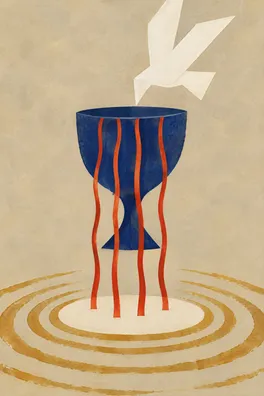
Ace of Cups
Upright
The Ace of Cups upright in What needs attention brings the emotional source of the work into focus. Its fresh opening may be curiosity, a sincere wish to help, a creative response or renewed interest in a neglected subject. You do not need to call that feeling a life purpose to take it seriously. It can simply show which part of your work still feels alive enough to explore.
Name a feeling accurately before turning it into a task. You might feel moved by a user’s difficulty, excited by a technique or disappointed that an important conversation has been left out. Each feeling suggests a different experiment. Express it in a form comfortable for you: a private note, a sketch, a short conversation or a small change in the brief. This gives the feeling somewhere to go without requiring a dramatic public declaration.
The alternative is that emotional intensity comes from novelty rather than lasting fit. That does not make it worthless, but it argues for exploration before a sweeping commitment. Notice whether interest remains when you encounter ordinary constraints. Equally, a quiet or tired day does not prove that meaningful work has lost its value.
03A small next step

Ace of Wands
Upright
The Ace of Wands upright in A small next step turns the opening into a first version. Its spark concerns creativity and the opportunity to act; it is a beginning that still needs room to grow. Rather than designing the whole future, make something small enough to reveal a real question. A rough outline, a sample interaction or an initial demonstration can make an idea easier to discuss.
Give the first version fifteen minutes and one purpose. You might test whether the central message is understandable or whether a proposed activity feels useful. Record what remains unknown when you stop. Then choose an appropriate person or situation for a limited response, making clear that the work is preliminary. The goal is information you can use, not instant approval.
The blind spot is mistaking the pleasure of starting for a plan to sustain the work. Before opening another new direction, decide when you will return to this version and what resource it needs next. If the experiment feels flat, change the scale or question before concluding that the entire impulse was mistaken. A spark becomes useful through contact, care and revision.
The Empress and the two Aces describe conditions, feeling and action working together. The nurturing card asks what the work needs; the Ace of Cups asks why it matters to you; the Ace of Wands gives that response a practical beginning. Having two Aces does not guarantee a successful launch. It emphasizes that the work is still taking shape and benefits from room to learn.
For the coming week, choose one living thread in your work instead of reorganizing everything. Supply one missing resource, write a sentence about the feeling that draws you toward it and make one small version. Seek feedback on a specific question. A reader can tell you where an explanation becomes unclear more usefully than whether your whole idea is good.
At your review, separate the idea’s appeal from the conditions of the experiment. Did the work receive the time or material it needed? Did the first version address the question you actually cared about? If not, adjust the conditions before judging the purpose. If both were present and the interest still faded, allow that information to guide a different next step. Care includes supporting growth and recognizing when another direction deserves attention.
A question to take with you
What is already growing in my work, what feeling connects me to it, and what modest first version would help me understand it better?