
Pick a group
A steadier voice, a lighter chapter, a more supportive home
Choose a group to explore self-trust, an unfinished responsibility, or belonging through a complete reading and a small experiment you can adapt.
· AI-assisted readings from randomly drawn cards. For reflection and entertainment.
Take a breath. Pick the group that draws you in.
Group 1
Group 1
Trusting yourself
What can help me listen to my own judgment?
01Where you are
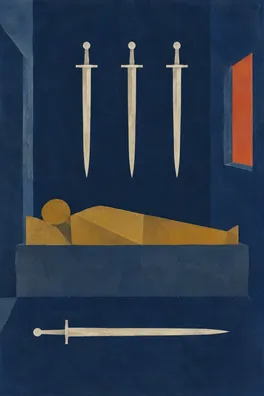
Four of Swords
Reversed
The Four of Swords reversed, in where you are, places self-trust at the boundary between recovery and returning to action. You may be ready to rejoin a task after a pause, or you may be so accustomed to staying mentally available that time off no longer feels restful. The reversal holds both possibilities. It does not establish that your judgment is poor; it asks about the conditions in which you are trying to hear it.
If you revisit a decision every evening, notice whether another round of thinking brings new information or repeats the same worries. For example, answering work messages during a break can keep every choice feeling unfinished. Try making a short interval genuinely unavailable to the task, then return to one clearly defined question. Compare how you understand it before and after the pause, without requiring yourself to feel perfectly calm.
Rest can also become a waiting room when the next step feels exposing. If you have had enough distance and keep postponing a modest action, a gentle return may be more restorative than another indefinite delay. Choose the smallest useful re-entry, such as writing the first sentence of an email. The distinction to watch is whether the step restores a sense of agency or recreates the pressure you were trying to escape.
02What needs attention
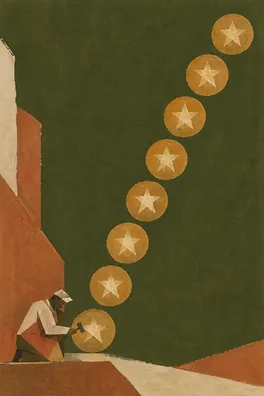
Eight of Pentacles
Upright
The Eight of Pentacles upright, in what needs attention, suggests that trust grows through specific, observable practice. Its craft is a counterweight to the demand to feel confident about everything at once. Judgment is easier to develop when you can identify a detail, try an approach and see what happened. This position asks you to give attention to the learning process rather than treating every choice as a verdict on your character.
Suppose you doubt your ability to communicate a boundary. Practice one sentence that states your availability plainly, then notice whether it conveyed what you intended. Or, if you are learning a task, compare one small piece of work with an earlier attempt and name the improvement. These observations give self-trust something concrete to stand on. Feedback can inform your judgment without taking ownership of it away from you.
The blind spot is turning diligent practice into an endless qualification process: one more course, one more rehearsal, one more person's approval before you are allowed to decide. Give the practice a defined scope and a finish. You are looking for enough understanding to make a proportionate choice, not proof that you will never be mistaken. An error you can describe and correct may teach more than a flawless-looking result you do not understand.
03A small next step

Three of Swords
Reversed
The Three of Swords reversed, as a small next step, brings the possibility of easing pain and releasing an old self-evaluation. In a reading about judgment, an earlier disappointment may still be serving as evidence that you cannot trust yourself. The reversal invites you to examine that conclusion. Recovery can include learning from what happened while allowing the whole story to be more complex than a single mistake.
Write down the thought that returns most often, then separate what you know happened, what you assume it means and what you need now. A missed opportunity might be a fact; being incapable of choosing well is a much larger conclusion. A present need could be clearer information or a more respectful conversation. Choose one change that answers the need, such as asking a direct question instead of replaying what you wish you had said.
An apology or reconciliation may be welcome, but this card does not require restoring a former relationship or persuading someone to agree with your account. You can make a small repair in how you speak to yourself even while feelings remain unsettled. Notice whether your new wording leaves room for responsibility and tenderness together. If it only excuses everything or condemns everything, return to the specific facts.
This group moves from the conditions for hearing yourself, through practice, toward a kinder relationship with past experience. The Four of Swords reversed warns that constant mental effort can blur your voice; the Eight of Pentacles gives that voice a concrete skill to develop; the Three of Swords reversed loosens the belief that an old disappointment has final authority. Self-trust here becomes a repeatable process of attention, action and revision.
There is a useful tension between the first two cards. More work is not always the answer, yet a deliberate practice can be the right way to return after a pause. Let its size tell you the difference. A short exercise with a clear finish may support you, while an open-ended demand to improve yourself can reproduce the restlessness. If the doubt concerns missing information rather than an old hurt, obtaining that information may be the most helpful first move.
This week, choose one low-stakes judgment you can make for yourself, such as how to spend a free half hour or how to phrase a routine request. Before deciding, take a brief quiet pause and write your reason in one sentence. Afterwards, record what you observed, what worked and what you would change. Repeat only when the exercise remains useful; this is a conversation with your experience, not a scorecard.
If you begin monitoring every feeling for evidence that you chose correctly, simplify the experiment. One observation at the end of the day is enough. Progress might look like explaining a choice more clearly or recovering from a small mistake without reopening your entire worth. What would help you treat your own judgment as something you can develop and repair?
A question to take with you
Which small piece of experience could I listen to without turning it into a verdict on myself?
Group 2
Group 2
An unfinished chapter
How can I approach something I have left unfinished?
01Where you are

Ten of Wands
Upright
The Ten of Wands upright, in where you are, suggests that the unfinished chapter may be tangled with a heavy load. A task can look like a failure of motivation when it actually contains several roles, obligations and unspoken expectations. Upright, this card recognizes effort already being made. It also asks whether carrying everything has narrowed your view of what completion could reasonably mean.
Consider a project that began as a simple favor and gradually made you responsible for planning, reminders and follow-up. You may avoid opening it because opening it means remembering all the other work attached. Lay out the actual pieces before asking yourself to try harder. Identify what you agreed to do, what became necessary later and what someone else could reasonably own.
The load might also be the cost of something you still value, such as finishing a course or organizing a family event. In that case, relief need not mean abandoning it. Move, postpone or share one task so the central work has room. Notice whether reducing the load restores interest. If it does not, the question may be about the project's present value rather than your willingness to work.
02What needs attention

King of Swords
Upright
The King of Swords upright, in what needs attention, brings clear criteria and fair judgment to the crowded scene. After the Ten of Wands, it asks for a decision you can explain: what counts as finished, what remains required and who has authority to accept a change. This is a way to organize responsibility without letting the loudest feeling decide every part of the plan.
For an unfinished application, distinguish necessary documents from improvements you would merely like to make. For a shared project, confirm the agreed deliverable rather than privately expanding it. Write two or three criteria and check whether you would apply them to someone else in the same circumstances. If you allow everyone else a reasonable limit but demand perfection from yourself, the rule deserves revision.
Clarity can become harsh when it treats embarrassment, sadness or loyalty as irrelevant. These feelings may explain why the chapter remains difficult even after the paperwork is clear. Give them a place without making them the sole judge. Where specialized knowledge is actually needed, ask an appropriate adviser a narrow question. Good authority can acknowledge the edge of its knowledge and say what evidence would change its view.
03A small next step

The Fool
Reversed
The Fool reversed, as the small next step, asks for balance between an impulsive fresh start and fear of beginning again. An unfinished task can tempt you to discard everything and launch a new version, or to wait until no uncertainty remains. The reversal points to the risk in both extremes. Here the next step benefits from preparation and a boundary, rather than a dramatic leap.
Choose a small experiment that genuinely touches the old chapter: open the draft and revise one section, ask whether an opportunity is still available, or make an inventory of materials already gathered. Before starting, name what you need, what you will spend in time or effort and where you will stop. A fifteen-minute session can produce information without silently committing you to finish the whole project that day.
The experiment is not useful if it becomes another way to circle around the real decision. After the stopping point, ask what you learned about feasibility and willingness. If the next step requires a promise you cannot meet, revise its scope before offering it. If the preparation is adequate but you keep adding safeguards, consider whether hesitation has become the remaining obstacle. You can proceed carefully while admitting that certainty will stay incomplete.
The Ten of Wands shows how an unfinished chapter can become too heavy to look at; the King of Swords makes its terms legible; the Fool reversed asks for a bounded return. Together they suggest that closure often begins by changing the conditions of the work. The task is easier to approach when its ownership, limits and purpose are explicit.
The tension is between duty and freedom. Responsibility does not require continuing every old commitment in its original form, while a desire to feel free does not automatically settle what you owe other people. A fair review may lead to completion, renegotiation or a clear ending. If the chapter is unfinished because a necessary person or resource is unavailable, an honest waiting plan may fit better than another attempt to push through alone.
This week, select one chapter and spend a short session listing its parts. Share or remove one burden, define an acceptable endpoint, then try one limited piece of work. If another person is involved, communicate the revised scope plainly. At the end, record whether you have more clarity about continuing, changing or closing the chapter, rather than judging the session only by how much you produced.
Adjust the experiment if it keeps uncovering new obligations or if the endpoint moves every time you approach it. That may call for a fresh agreement, not greater endurance. A chapter can be handled responsibly without being completed exactly as you once imagined. What form of closure would respect both your present capacity and the people affected?
A question to take with you
What would an honest, manageable definition of finished look like now?
Group 3
Group 3
Home and belonging
What would make my sense of home feel more supportive?
01Where you are

The Tower
Upright
The Tower upright, in where you are, examines what happens when an assumption about home stops holding. Its intensity can describe a disruption already experienced, but it can also name the moment you recognize that an arrangement is less dependable than you thought. This card does not announce a coming disaster. It invites a clear look at the foundation that currently supports your daily life.
Perhaps a change in schedules has exposed how much the household depended on one person's invisible labor, or a conversation has challenged an old definition of belonging. Begin with what is actually changing. Separate a practical issue, such as access to a quiet space, from the broader meaning you are giving it. A specific problem is often easier to address when it is not carrying every fear about whether you belong.
Review the backup plan for one important commitment: who can help, where essential information is kept, or what alternative arrangement is available. The aim is to make support more visible. The blind spot is treating every imperfection as proof that the entire structure must go. Some foundations need significant change; others need an honest repair and a different distribution of responsibility. Let current circumstances determine the scale.
02What needs attention

The Hermit
Upright
The Hermit upright, in what needs attention, offers quiet reflection after the Tower's exposure. When an old arrangement changes, other people's definitions of a good home can rush in to fill the space. This position asks you to hear your own experience before adopting the loudest answer. Solitude here is a tool for discernment, with room for guidance from someone whose experience you trust.
Give yourself ten uninterrupted minutes with one question: when have I felt most able to be myself in an ordinary living space? Recall the conditions rather than an ideal picture. It may have been a predictable routine, privacy, a welcoming conversation or permission to leave a task unfinished. Naming the condition can reveal something you might recreate even if the former place or relationship is no longer available.
Quiet can become withdrawal if it keeps you from asking for help or leaves others guessing about your needs. After reflecting, translate one insight into a request that another person could understand. If you live alone, consider a trusted person or a regular place where connection feels possible. The Hermit's guidance is more useful when it helps you return with a clearer sense of what support means to you.
03A small next step

Ace of Wands
Upright
The Ace of Wands upright, as a small next step, brings a spark of possibility into a reading that began with disruption. It suggests making a first version of something supportive, rather than waiting for a complete vision of home. Upright, the card favors interest and initiative; an opening has energy, but it still needs time, consent and practical space to grow.
Spend fifteen minutes beginning one change drawn from the Hermit's reflection. You might make a small reading corner, propose a shared meal with a clear division of work, or begin a recurring visit to a place where you feel welcome. Choose an action within your circumstances and ask before changing shared space. A first version should help you discover what fits, not create a new standard everyone must maintain.
The blind spot is making a burst of inspiration responsible for repairing everything the Tower revealed. A welcoming ritual cannot resolve an unfair agreement by itself, although it can offer a meaningful start while the agreement is addressed. After trying the change, notice who feels supported, what effort it requires and whether you want to repeat it. Interest that survives ordinary use is a better guide than the excitement of the first afternoon.
The Tower, the Hermit and the Ace of Wands move from an exposed assumption through personal discernment to a living experiment. Their sequence allows belonging to be rebuilt from actual needs. You do not have to reproduce an earlier picture of home before you can make one part of daily life more supportive.
The cards also challenge one another. The Tower can make everything feel urgent, while the Hermit asks for enough quiet to distinguish the essential from the overwhelming. The Ace of Wands prevents reflection from becoming permanent retreat. If there has been no major disruption, this group may fit a quieter recognition that a familiar routine no longer serves you. The scale of the response can stay small.
For the coming week, name one condition that helps you feel at home and choose a modest way to offer it. Before starting, check the practical support for it and involve anyone who shares the space or responsibility. Try the change twice if circumstances allow, leaving time afterwards to notice whether it made daily life easier. A useful result could be a clearer request, a more reliable routine or a small place where you can settle.
If the experiment adds work for the person already carrying the most, change the arrangement. If it offers comfort but leaves a larger problem untouched, keep its comfort in proportion while addressing that problem directly. Belonging can grow through repeated acts of attention, with enough flexibility to include the people you are now. What small beginning would make support easier to experience in ordinary life?
A question to take with you
Which condition helps me feel at home, and how could I make room for it this week?